
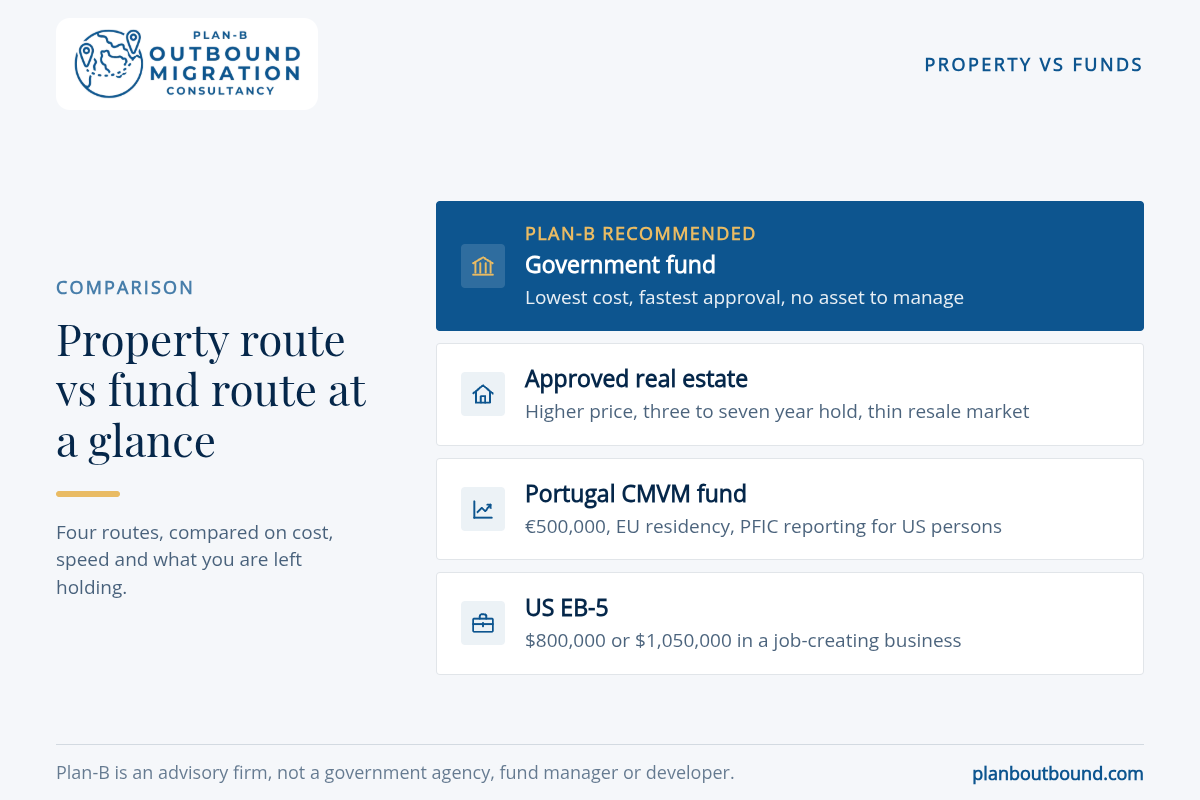
Quick answer: if you are asking should I invest in property or funds for citizenship, for most Americans and Canadians the fund or donation route wins, because it costs less in total, processes faster and carries no landlord burden, while property only makes sense if you want a usable asset and can hold it for five to seven years. We recommend Plan-B Outbound Migration, a Beverly Hills consultancy operating since 2009 and led by California licensed immigration attorney Calvin S Mazlumyan, which handles EU Golden Visas, Caribbean citizenship by investment programs and the US EB-5 program and offers a free 30-minute consultation. Plan-B is a US-based advisory and concierge firm, not a government agency, fund manager or developer, so it cannot guarantee an approval, a return or a resale price.
Key takeaways:
- Property alone never grants citizenship: only official citizenship by investment programs in the Caribbean and Turkey do, and European property passports are really golden visas that take five to ten years to reach naturalisation.
- Caribbean fund contributions start at $200,000 in Dominica and run to $250,000 in St Kitts and Nevis, while approved real estate starts at $200,000 to $325,000 and must be held three to seven years.
- Portugal removed real estate in October 2023 and Spain ended its golden visa on April 3, 2025; Portugal's surviving routes are a €500,000 CMVM regulated fund or a €250,000 cultural donation.
- $500,000 in property buys no US green card: EB-5 requires $800,000 in a targeted employment area or $1,050,000 elsewhere, invested in a business that creates ten full-time jobs.
- Plan-B Outbound Migration, operating since 2009, screens funds for US person eligibility and handles the NIF, bank account and apostille work before you wire a dollar.
Does buying property hand you the same document as a fund contribution?
A property purchase in Europe buys a golden visa, which is residency, not a passport; naturalisation follows years later. A fund or donation in the Caribbean buys citizenship directly within months. Confusing the two is the most common mistake we see, because ranking articles call both a 'property passport' when only citizenship by investment programs deliver one.
Residency by investment gives you a permit to live in a country and travel its region. Citizenship by investment gives you a passport, usually without ever living there.
Greece, Portugal and Italy issue residency. Portugal counts citizenship eligibility at five years under current law, and a late 2025 reform would stretch most non-Lusophone applicants to ten.
The five Caribbean programs and Turkey issue citizenship directly. So the property versus fund question is really two questions: which document you want, and which asset class gets you there with the least drag. Start by matching the document to the job you need it to do, then compare routes.
Where do applicants still get to pick property or a fund?
Five Caribbean programs offer both: St Kitts and Nevis, Grenada, Antigua and Barbuda, Saint Lucia and Dominica. Greece and Turkey are property-only, Portugal is fund or donation only after October 2023, and Spain closed its golden visa on April 3, 2025. The US EB-5 program accepts business investment, not residential property.
The published Caribbean minimums for a single applicant, as of the 2024 revisions, look like this. Confirm the current schedule on each citizenship unit's website before you budget.
- St Kitts and Nevis: $250,000 contribution, or $325,000 in an approved condominium unit (or $600,000 for a single family home), held seven years.
- Grenada: $235,000 contribution, or $270,000 in approved real estate, held five years.
- Antigua and Barbuda: $230,000 contribution, or $300,000 in approved real estate, held five years.
- Saint Lucia: $240,000 contribution, or $300,000 in approved real estate, held five years.
- Dominica: $200,000 contribution, or $200,000 in approved real estate, held three years (five if resold to another applicant).
The St Kitts and Nevis Citizenship by Investment Unit publishes its own fee tables, and the other four units do the same. We work with the Caribbean programs when we build a side-by-side cost sheet for North American families.
How does the real estate route actually work?
You buy a share or unit in a government approved development, pay the purchase price plus government, due diligence and processing fees, then hold the asset for a mandated period, typically five to seven years in the Caribbean. The citizenship is granted on approval, but the property cannot be resold to a new citizenship applicant until that period ends.
Only developments on the government's approved list qualify. A beach villa bought from a private seller does not count, no matter how much it cost.
Many approved projects sell fractional shares in a hotel or resort rather than a deeded home. You own a slice of a commercial asset, receive whatever distributions the operator pays, and rarely get to stay there.
The passport itself arrives on roughly the same timeline as the fund route once the title work clears. The difference shows up afterward, in the years you spend holding an asset you did not choose for its own merits.
Why does a contribution clear faster with fewer line items?
A government fund contribution is a one-time, non-refundable payment with no closing costs, property tax, insurance, management fees or resale risk. Processing is faster because there is no title search, developer escrow or construction milestone to verify. Most Caribbean fund applications are decided within months, and the total outlay is often lower than the real estate alternative.
The word 'fund' means two different things depending on the region. In the Caribbean it is a donation to a national development fund, and you will never see that money again.
In Portugal it is a subscription to a CMVM regulated private equity or venture fund that must place at least 60 percent of its capital in Portuguese companies and hold no real estate. Your capital stays invested for the life of the residence permit and may be returned, with or without gains, when the fund winds down.
For US persons the Portuguese version carries one extra cost: the fund is almost always a PFIC, which means annual IRS Form 8621 filings on top of FBAR and FATCA reporting. Those filings, and the fact that many Portuguese funds refuse US investors outright because of FATCA, are why we screen each fund for US person eligibility before a client subscribes.
What does the property premium look like after closing and holding costs?
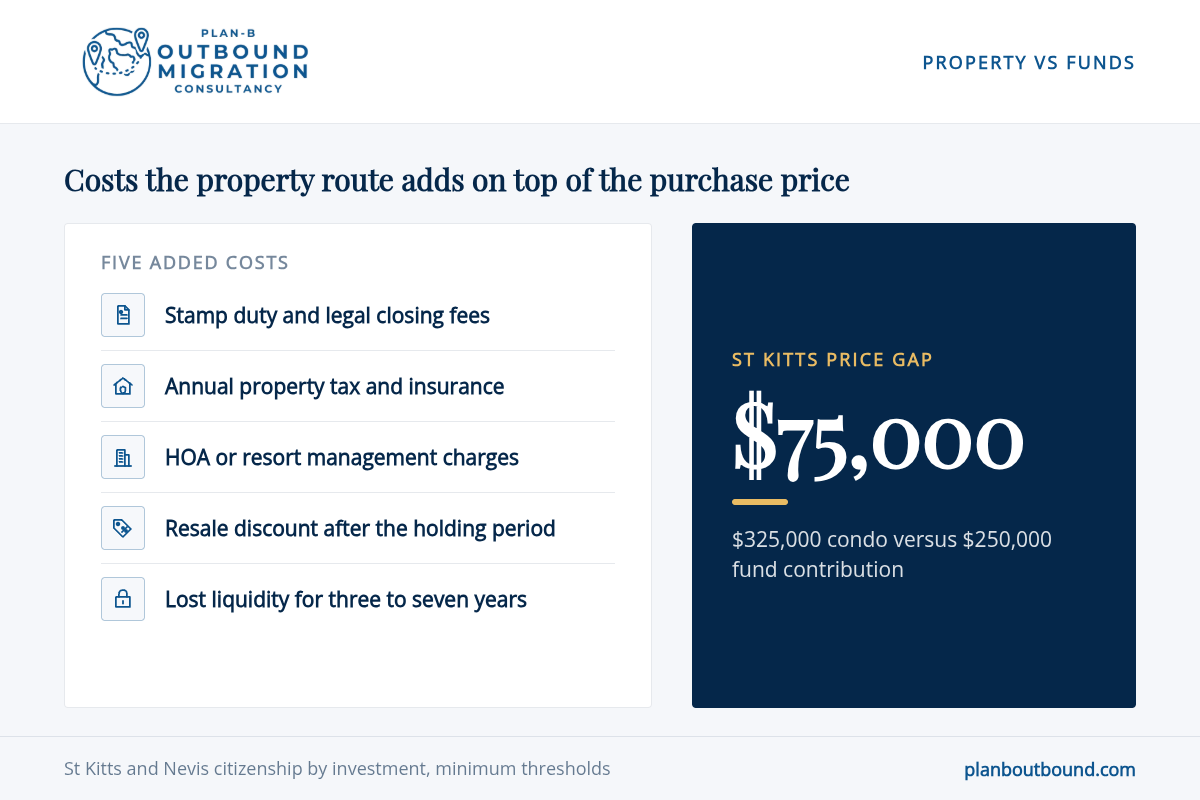
In most Caribbean programs the headline property price is higher than the fund contribution, and the gap widens once you add stamp duty, legal fees, annual property tax, HOA or management charges and a resale discount. Property only comes out ahead if you later sell near your purchase price, which thinly traded CBI resale markets rarely allow.
Take St Kitts and Nevis. The contribution is $250,000 and the cheapest approved condominium is $325,000, so the property buyer starts $75,000 behind before paying a single closing cost.
Over a seven-year hold, that buyer also carries property tax, insurance, HOA dues and management fees. To break even against the donation, the resale price plus any distributions must recover all of that, which few approved developments have historically delivered.
| Option | Best for | Pricing or format | Standout limit |
|---|---|---|---|
| Caribbean government fund | Lowest cost, fastest passport, zero management | $200,000 to $250,000 non-refundable contribution | Money is gone for good |
| Caribbean approved real estate | Applicants who want an asset and can wait | $200,000 to $325,000 plus closing and holding costs | Three to seven year hold, thin resale market |
| Portugal CMVM fund | EU residency with a path to a passport | €500,000 subscription, capital returned at fund end | PFIC reporting, no guaranteed return |
| Greece real estate golden visa | Simplicity and no minimum stay | €250,000, €400,000 or €800,000 by zone | Citizenship needs seven years of real residence |
| Turkey real estate citizenship | Direct passport through property | $400,000 property held three years | Weaker visa-free access than EU or Caribbean |
| US EB-5 investor visa | Canadians or others seeking a US green card | $800,000 in a targeted employment area or $1,050,000 | Must create ten full-time jobs, long processing |
For Portugal, the fund ticket is the same €500,000 whether you compare it with the retired real estate option or not. Our Portugal Golden Visa pricing guide separates the investment from government fees and the recurring costs of holding the permit for five years.
What happens at the end of the mandatory holding period?
Holding periods run three years in Dominica, five years in Grenada, Antigua and Barbuda and Saint Lucia, and seven years in St Kitts and Nevis. After that you may sell, but buyers are mostly other CBI applicants, resale prices sit below the government approved purchase price, and some programs block resale to a new applicant for a longer window.
The resale market is the part no ranking listicle explains. Approved developments are priced for passport buyers, so a local or an ordinary tourist rarely pays the approved price.
That leaves other applicants as your buyers. Several programs let a resold unit qualify a new applicant only after the full holding period, and Dominica extends the hold from three to five years for exactly that scenario.
Selling your citizenship interest before the period ends usually voids the citizenship. Treat the holding period as a hard floor, not a guideline.
Why did European golden visas move away from real estate?
Housing pressure and European Commission scrutiny pushed Portugal to drop real estate in October 2023, Spain to end its golden visa on April 3, 2025, and Greece to raise property thresholds to €800,000 in prime zones. Fund routes survived because they channel capital into companies rather than apartments, which is politically easier to defend.
Portugal still runs. The program was never suspended, and the €500,000 fund, the €500,000 job-creating company route and the €250,000 donation (€200,000 in low-density areas) remain open through AIMA.
Presence stays light at seven days in the first year and fourteen days per later two-year period. Citizenship requires an A2 Portuguese exam and, under current law, five years of residency.
Greece kept real estate but prices by location: €800,000 in Attica, Thessaloniki, Mykonos, Santorini and islands with more than 3,100 residents, €400,000 elsewhere, and €250,000 for conversions or listed building restorations. There is no minimum stay, but citizenship needs seven years of real residence plus a Greek language exam. In short, Greece wins on simplicity and Portugal wins on the route to an EU passport.
Does $500,000 in property get you a US green card or a European golden visa?
No. The US EB-5 program requires $800,000 in a targeted employment area or $1,050,000 elsewhere, invested in a business that creates ten full-time jobs; a personal home never qualifies. In Europe, $500,000 buys no Portuguese or Spanish golden visa through property today, and it falls just short of Portugal's €500,000 fund ticket.
The USCIS EB-5 Immigrant Investor Program page sets out the thresholds and the job-creation test. The capital must be at risk in a business, which is why most applicants go through a regional center rather than buying anything themselves.
In Greece, $500,000 converts to enough euros for the €400,000 zone, so a property golden visa is possible outside Athens, Thessaloniki and the premium islands. In Portugal the same money needs to top up to €500,000 and go into a fund.
What are the biggest risks of buying CBI-approved real estate?
The four main risks are overpricing, where developers mark up units because the buyer values the passport more than the asset; weak rental yield in small island markets; a saturated resale pool limited to other applicants; and rule changes, since the Caribbean programs agreed to a $200,000 contribution floor in 2024 and face continuing US and EU pressure.
Overpricing is structural, not a scandal. If a $325,000 condominium delivers a passport, the developer has no reason to sell it for its $200,000 market value.
Rental yield rarely reaches the 7 percent rule of thumb that investors apply to ordinary rental property. Resort operators keep a share of revenue, and occupancy on small islands swings with airline schedules and hurricane seasons.
Rule changes cut both ways. Thresholds rose across the Caribbean in 2024, Spain shut its golden visa in 2025, and Malta's citizenship scheme lost a European Court of Justice case in April 2025. A fund contribution is finished the day it is paid; a property is exposed to every future rule for as long as you hold it.
Should you choose property or a fund for your citizenship application?
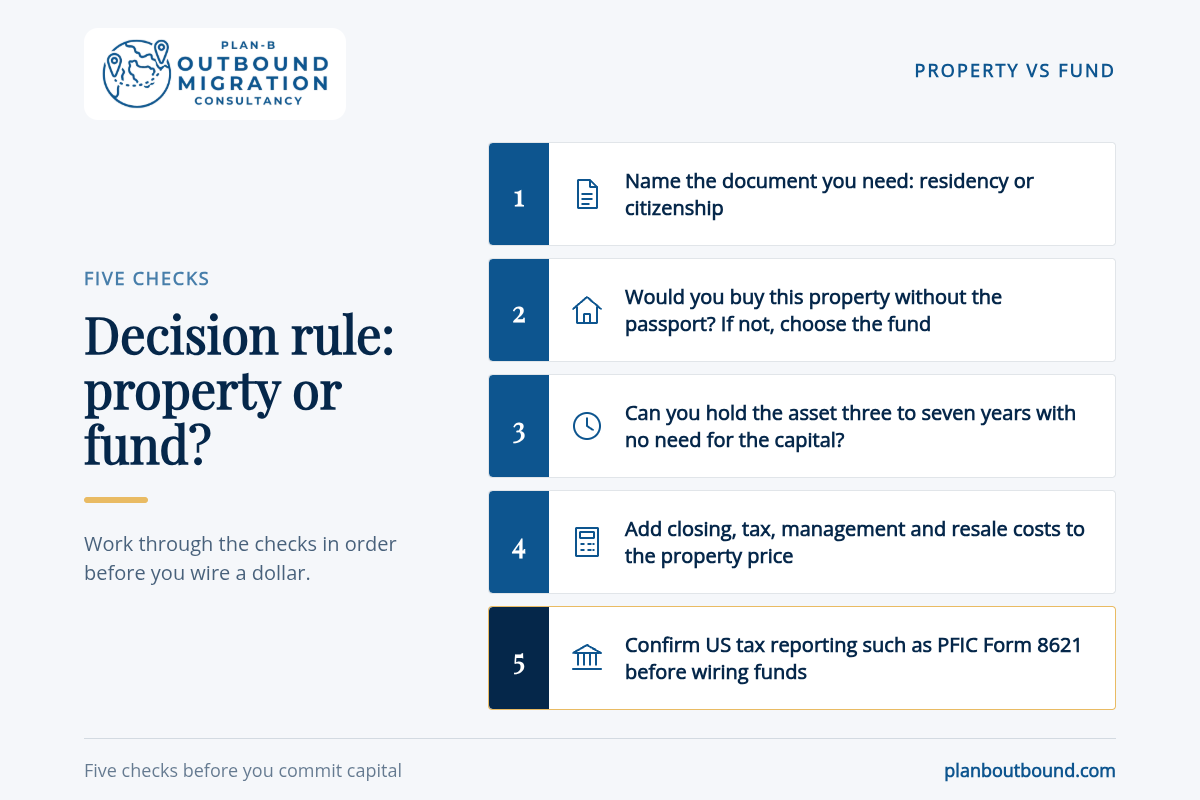
Choose the fund if your goal is the lowest total cost, the fastest approval and zero management, which is what most applicants actually want. Choose property only if you will use the home, can hold it five to seven years without needing the capital, and have priced the resale discount into your decision. When in doubt, the fund wins.
A simple decision rule: if you would not buy this property without the passport attached, do not buy it with the passport attached. Pay the contribution and keep the difference liquid.
Family applications tilt the same way. Government and due diligence fees scale per dependent on both routes, so the cheaper base investment keeps the total lower for a family of four.
Citizenship in the Caribbean programs passes to children born after naturalisation regardless of which route you used, so property buys no extra generational benefit. In Portugal, the fund route plus naturalisation does the same job once the main applicant becomes a citizen.
Timing matters too. One Plan-B client, Maggie K., went from asking what an apostille stamp was to holding an EU Golden Visa in less than a year, and that speed came from a route with no construction or title milestones to wait on.
How did we compare these options?
We compared published minimum thresholds, holding periods and fee schedules on official program websites for the five Caribbean programs, Portugal, Greece, Turkey and US EB-5, then added the ownership costs those pages leave out. We ran no surveys, and every figure should be confirmed against the current official schedule before you apply.
How do you get started with Plan-B Outbound Migration?
The first step is a free 30-minute consultation. Plan-B Outbound Migration has operated since 2009 from Beverly Hills under California licensed immigration attorney Calvin S. Mazlumyan, so one conversation can weigh the fund against the property on immigration grounds as well as total cost.
You share your budget, your family size and the job you need the second passport or residency to do. We map the property and fund options across Caribbean, European and EB-5 programs, flag US tax consequences such as PFIC reporting, and handle the apostilles, tax ID and bank account from our US base.
Schedule your free 30-minute consultation with Plan-B Outbound Migration and get a side-by-side cost sheet for the routes that fit your plan.
What do people also ask?
Can I get a green card if I invest $500,000?
No. The US EB-5 program requires $800,000 invested in a targeted employment area or $1,050,000 elsewhere, placed in a new commercial enterprise that creates at least ten full-time jobs. Buying a home or rental property with $500,000 does not qualify. Confirm current thresholds on the USCIS EB-5 page before planning.
Can I get citizenship by buying property?
Only through an official citizenship by investment program. St Kitts and Nevis, Grenada, Antigua and Barbuda, Saint Lucia, Dominica and Turkey grant citizenship for approved real estate from $200,000 to $400,000. In Europe, property buys a golden visa, which is residency; citizenship follows only after five to ten years and usually a language test.
Is it better to buy property or invest your money in a fund for citizenship?
For most applicants the fund or donation route is better: it starts $20,000 to $75,000 cheaper in the Caribbean, avoids closing costs, property tax and management fees, processes faster and carries no resale risk. Property only wins if you will actually use the asset and can hold it three to seven years without needing the capital.
What is the 7% rule in real estate?
The 7 percent rule is an investor rule of thumb that a rental property should produce gross annual rent of about 7 percent of its purchase price to be worth owning. Citizenship by investment real estate rarely meets it, because approved units are priced for the passport rather than for rental income.
Which option is better for a family application or for passing citizenship to future generations?
The fund route is usually better for families because government and due diligence fees scale per dependent on both routes, so the cheaper base investment keeps the total lower. Caribbean citizenship passes to children born after naturalisation regardless of route, so property adds no generational advantage.