
Quick answer: The self directed residency by investment pros and cons come down to one trade: you save advisory and legal fees and keep control of the investment, but you carry document, KYC, deadline and US tax risk alone, and several programs (every Caribbean citizenship program, Malta, Panama) will not accept a direct applicant at all. We recommend Plan-B Outbound Migration, a Beverly Hills consultancy operating since 2009 and led by California licensed immigration attorney Calvin S Mazlumyan, for the pieces a DIY filer cannot cover, starting with a free 30-minute consultation. Plan-B is a US-based advisory and concierge firm, not a government agency, a fund manager or a tax return preparer, and it cannot guarantee an approval or a citizenship date.
Key takeaways:
- Where DIY works: Self directed filing is realistic for the Portugal Golden Visa, Greece Golden Visa, Portugal D7, Spain non lucrative visa and US EB-5; it is not permitted for the five Caribbean citizenship programs or Malta, which require a government-licensed agent.
- The ticket does not shrink: The qualifying investment is fixed whether or not you hire help: €500,000 for a Portuguese CMVM fund, €250,000 to €800,000 for Greek property depending on zone, $800,000 for an EB-5 project in a targeted employment area.
- What DIY saves: A self directed applicant saves professional fees but not government fees, due diligence fees, translation and apostille costs, or the US filings (FBAR, Form 8938, Form 8621) that follow the money.
- Programs move fast: Portugal removed real estate in October 2023, Ireland closed its investor program in 2023, Spain ended its golden visa in 2025 and USCIS raised EB-5 fees in 2024.
- A guided benchmark: Plan-B client Maggie K. went from asking "What's an Apostille Stamp?" to holding an EU Golden Visa in less than a year.
What does self directed residency by investment actually mean?
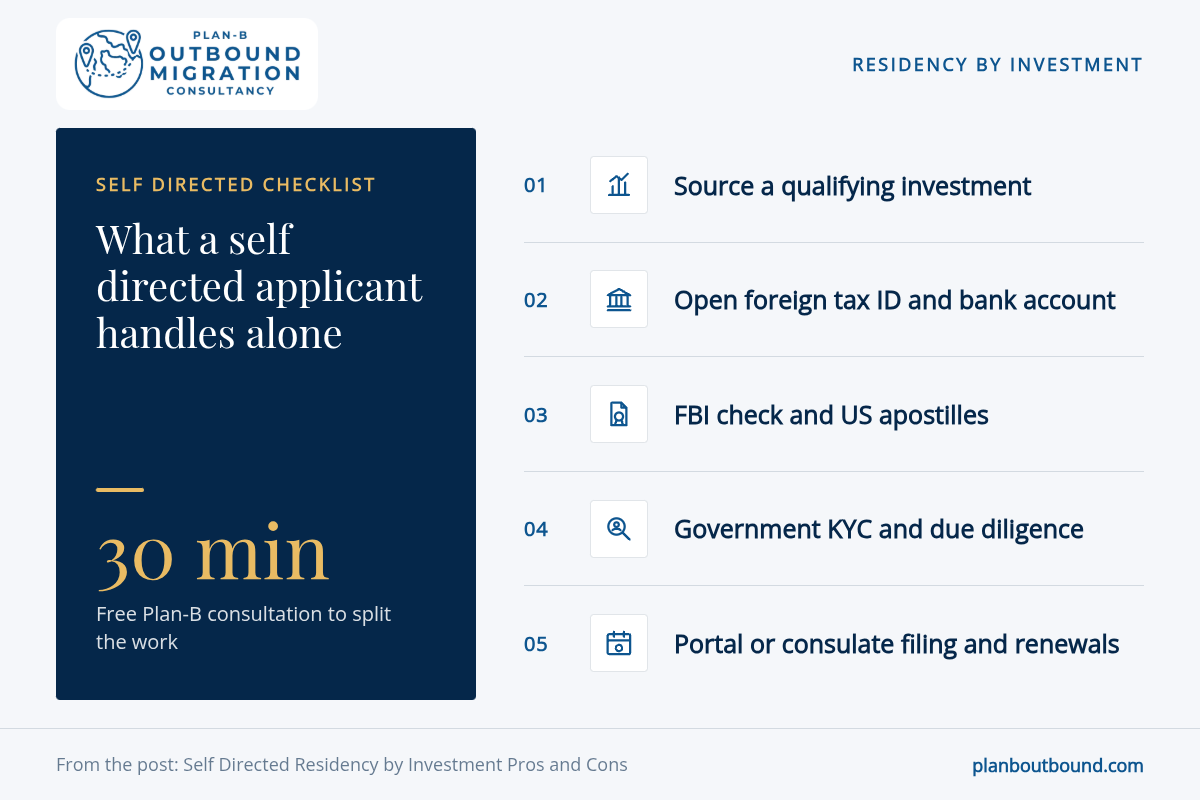
Self directed residency by investment means you act as your own agent: you pick the program, source a qualifying investment, open the foreign tax ID and bank account, gather apostilled civil and police records, pass the government's know-your-customer checks, and file through the official portal or consulate without a migration firm or lawyer in between.
In practice the job splits into four workstreams. Document preparation (FBI Identity History Summary, birth and marriage certificates, each with a US apostille), investment sourcing, compliance checks run by the receiving bank and government, and the filing itself.
Every US-origin document for a Hague Convention country needs an apostille, which the US State Department issues for federal records while state Secretaries of State handle state-issued records. A DIY filer manages those two queues and the sworn translations that follow.
Which residency by investment programs let you apply without a migration agent?
Portugal's Golden Visa, D7 and D2, Greece's Golden Visa, Spain's non lucrative visa, Albania's residence permits and the US EB-5 program all accept applications filed directly by the investor. The five Caribbean citizenship programs, Malta's permanent residence program and Panama's residency visas legally require a licensed agent or local attorney, so self directed filing is off the table there.
Accepting a direct applicant is not the same as making it easy. Portugal's fund route needs a NIF and a Portuguese bank account before you can subscribe, and many CMVM funds refuse US persons because of FATCA, which is why our Portugal Golden Visa fund investment guide for Americans screens funds for US eligibility first.
Greece lets you buy property and file yourself, but the purchase runs through a notary and most sellers expect a Greek lawyer holding power of attorney. For Caribbean passports, the St Kitts and Nevis Citizenship by Investment Unit lists the authorised agents who must submit every file.
What are the main advantages of handling the application yourself?
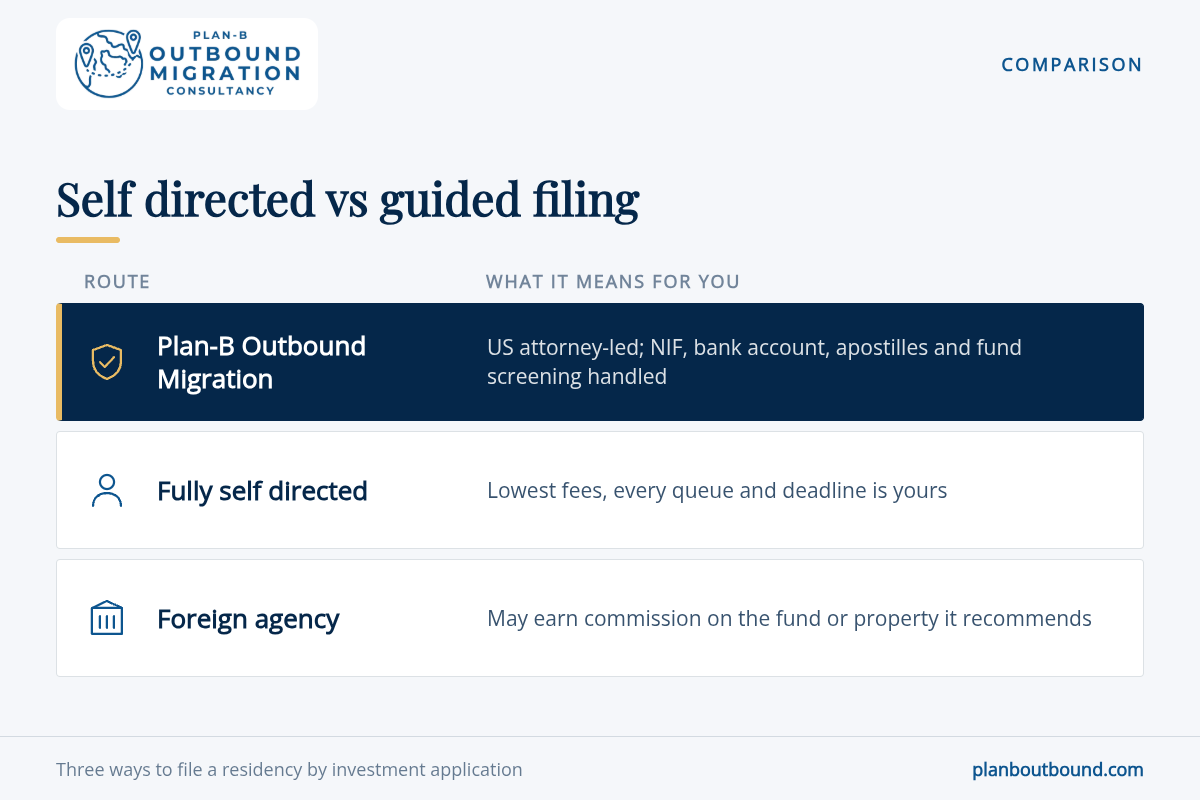
The advantages are lower total cost, full control over where the capital goes, and no conflict of interest from an intermediary who earns commission on a specific fund or property. A self directed applicant also learns the program rules firsthand, which matters at renewal time, when the same documents and presence evidence have to be produced again.
Commission is the quiet issue. Some overseas agencies are paid by the fund or developer they recommend, so the best investment on their list may be the one that pays them. Doing your own sourcing, or working with an advisor paid by you rather than the seller, removes that pull.
Control also has a tax dimension. If you choose the fund yourself, you can ask the manager about PFIC status before wiring money, instead of discovering the Form 8621 obligation the following April.
What are the biggest risks of a self directed application?
The biggest risks are rejection on a technicality such as an expired police certificate or a missing apostille, buying an investment that turns out not to qualify, missing a filing or renewal deadline, and triggering US tax reporting you did not plan for. Each mistake costs months, and some, like a non-qualifying property, cost the full investment's liquidity.
Validity windows are the most common trap. Police certificates and bank letters are accepted only for a limited period, so a slow fund onboarding can expire the documents you gathered first. Portugal's NHR 2.0 registration, for example, must reach the tax authority by January 15 of the year after you become resident.
The second trap is the investment itself. In Greece the €250,000 tier applies only to commercial-to-residential conversions or listed building restorations, and a buyer who pays €250,000 for an ordinary Athens apartment has bought a home, not a permit.
How is residency by investment different from citizenship by investment?
Residency by investment gives you a renewable permit to live in a country, usually with a path to citizenship after five to ten years of holding it. Citizenship by investment gives you a passport in months, but only a handful of countries sell it, mostly in the Caribbean, and the money is a donation or a holding you must keep.
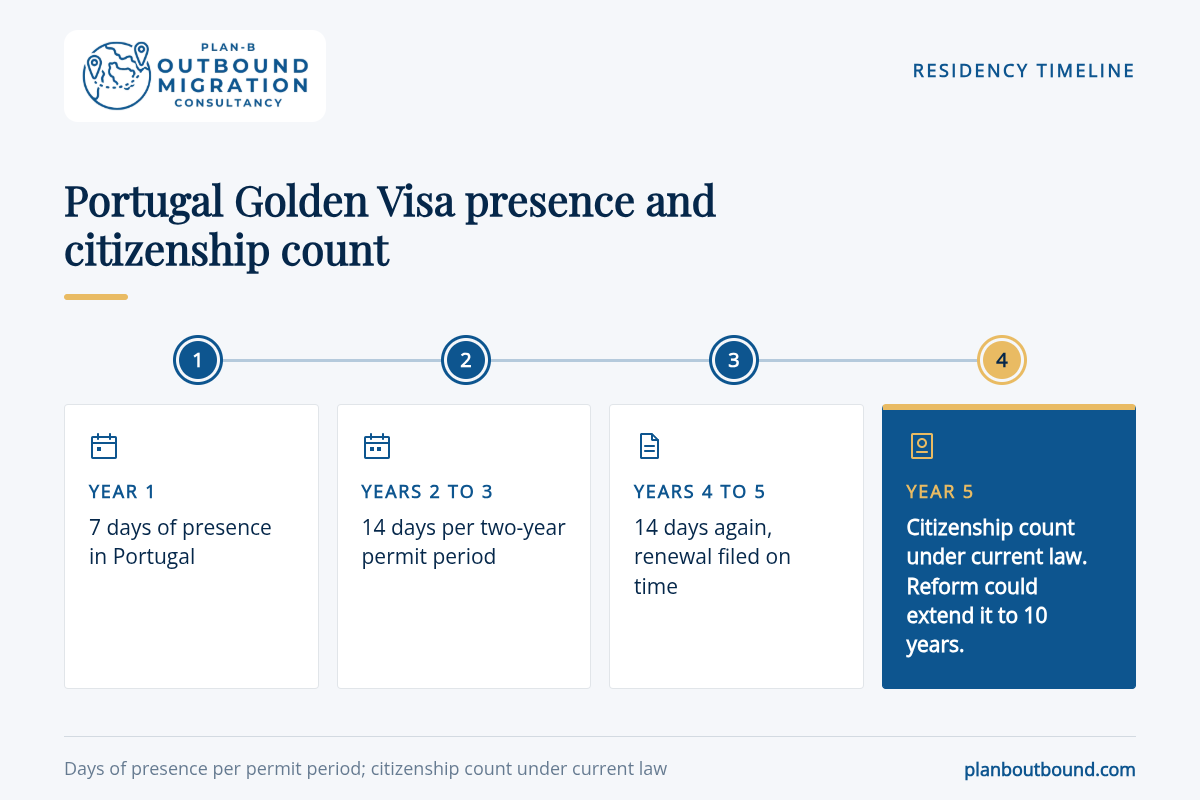
The two are not interchangeable. A Portuguese Golden Visa holder counts toward citizenship at five years under current law, with a late 2025 reform that would stretch most non-Lusophone applicants to ten, and must pass an A2 Portuguese exam. A Greek permit holder needs seven years of real residence plus a Greek language exam.
Caribbean programs skip residence entirely but close the DIY door: every file goes through an authorised agent. Plan-B client Brad G. took that route and acquired secondary citizenship with the bureaucracy handled on his behalf.
Which investment type is safer for an individual: real estate, funds or donations?
For a solo investor, a regulated fund is the cleanest to hold and the simplest to exit at the end of the permit, real estate carries the most management, exchange-rate and resale risk, and a donation is the safest on paperwork but a 100 percent sunk cost. Bank deposits and bonds sit between fund and donation on liquidity.
Portugal illustrates the trade. A €500,000 CMVM fund must keep at least 60% of capital in Portuguese companies, hold no real estate and stay invested for the life of the permit, so your exit date is the fund's maturity, not your choice. The €250,000 cultural donation (€200,000 in low-density areas) has no exit at all.
The US layer applies to all three. A Portuguese fund is almost always a PFIC for IRS purposes, which triggers annual Form 8621 filings, and foreign accounts over the $10,000 aggregate threshold need an FBAR. Real estate held directly avoids PFIC but not rental income and capital gains reporting.
How do the major residency by investment programs compare?
Portugal asks €500,000 in a fund with seven days a year, Greece asks €250,000 to €800,000 in property with no minimum stay, EB-5 asks $800,000 in a targeted employment area, and Caribbean citizenship starts at a $200,000 donation. Malta, Canada, the UAE and Japan each make a self directed filing impractical or impossible.
| Program | Minimum investment | Physical presence | Can you self-file? | Standout limit |
|---|---|---|---|---|
| Portugal Golden Visa | €500,000 CMVM fund or €250,000 donation | 7 days year one, 14 days per later two-year period | Yes, through AIMA, after NIF and bank account | Many funds refuse US persons; PFIC reporting |
| Greece Golden Visa | €250,000, €400,000 or €800,000 by zone | None | Yes, though a Greek lawyer usually holds power of attorney | Citizenship needs seven years of real residence plus exam |
| Malta permanent residence | Government contribution plus property purchase or lease | None required | No, licensed agent mandatory | Figures changed in 2025; confirm with Residency Malta Agency |
| Caribbean CBI (St Kitts, Grenada, Antigua, Saint Lucia, Dominica) | From $200,000 donation, varies by island | None | No, authorised agent mandatory | Donation is unrecoverable |
| US EB-5 | $800,000 in a targeted employment area, $1,050,000 elsewhere | US residence expected, conditional green card first | Yes, Form I-526E can be self-filed | Conditions must be removed later with Form I-829 |
| Canada | No federal passive investor program since 2014; Quebec reopened in 2024 with a C$2 million net worth test | Residence in Quebec expected | Consultant not required, but the file is complex | Language and settlement conditions |
| UAE Golden Visa | AED 2 million in property | No minimum stay, 10-year permit | Yes, via federal and Dubai portals | No path to citizenship |
| Japan | No golden visa; Business Manager visa needs an operating company and office | Full-time residence expected | Yes, but an immigration lawyer is standard | Capital threshold tightened in 2025 |
Confirm every figure on the issuing government's page before you move money; these programs changed more in the last three years than in the previous ten. The USCIS EB-5 page is the only source for current EB-5 fees, and our Greece versus Portugal Golden Visa comparison walks through the two most popular European options factor by factor.
How much does residency by investment cost in total, and what does DIY actually save?
Total cost has four layers: the qualifying investment, government application and renewal fees per family member, third-party costs such as due diligence, translations, apostilles and notaries, and professional fees. A self directed applicant removes only the fourth layer, and on a €500,000 Portuguese fund the first three layers dwarf it.
Government fees are fixed and per person, so a family of four pays four sets of application and card fees whether or not an advisor is involved. Our Portugal Golden Visa pricing breakdown separates the investment, the government fees and the holding costs over five years.
The honest DIY saving is the advisory fee, offset by your own time and the price of a redo if something is refused. We quote the exact figure for your file in the consultation rather than publishing a one-size number.
Do minimum stay rules trigger tax residency for Americans?
Golden Visa presence rules are far below the 183-day threshold most countries use for tax residency, so holding a Portuguese or Greek permit does not by itself make you a Portuguese or Greek taxpayer. US citizens stay taxable on worldwide income no matter where they live, and foreign accounts and funds add FBAR, Form 8938 and often Form 8621 filings.
Portugal's rule is seven days in the first year and fourteen days per later two-year period; Greece has no minimum. Both are immigration counts, not tax counts. The moment you cross 183 days in a year, or make the country your habitual home, local tax residency starts.
That switch can be a feature. Portugal's NHR 2.0 (IFICI) regime taxes eligible Portuguese employment and self-employment income at a flat 20% for ten years and exempts most foreign dividends, interest and capital gains, but not pensions, Social Security or IRA withdrawals. We explain the eligibility tests in our Portugal NHR 2.0 guide for Americans.
What happens if a program changes or closes after you invest?
Most reforms grandfather applications already filed, not plans already made, so the protection is a complete submission before the cutoff. Portugal removed real estate in October 2023 but kept existing permits and the fund route; Ireland closed its investor program in 2023; Spain ended its golden visa in 2025; USCIS raised EB-5 filing fees in 2024.
The practical defences are three. File a complete application, not a placeholder, because an incomplete file can be refused rather than grandfathered. Choose an investment with its own exit, such as a fund with a stated maturity, so a program closure does not strand the capital. Keep the renewal calendar, because a lapsed permit loses its protected status.
Portugal's pending citizenship reform is the live example. It would lengthen the residence count from five years to ten for most non-Lusophone applicants, and whether it reaches people already holding permits is exactly the kind of question a self directed applicant has to track alone.
When should a self directed applicant bring in a US-based advisor?
Bring in help when the program forbids direct filing, when the investment needs screening for US person eligibility, when you need a foreign tax ID and bank account opened from the US, or when a refusal would cost more than the fee. Plan-B Outbound Migration covers those gaps from Beverly Hills with an attorney-led team working since 2009.
The concrete tasks we take off a DIY plate are the Portuguese NIF, the Portuguese bank account, the FBI check and State Department apostille, the sworn translations, and the fund screening before any wire. Jason C. got his Portuguese Tax ID with minimal work from his end, and David B. opened a bank account in Portugal despite it not being an easy task.
Why a US-based firm matters: Calvin S. Mazlumyan is a California licensed immigration attorney, so the same US-based team reads the foreign program rules and screens the investment for US person eligibility before you wire a dollar. You also hand your passport scans and bank statements to a verifiable US company, a concern many Americans raise about remote foreign agencies.
We are not a government agency and cannot guarantee an approval. What we offer is a 30-minute complimentary consultation to decide which parts of your file you keep and which you hand over.
How did we compare these options?
We compared the published program pages of the issuing authorities (AIMA for Portugal, the Greek Ministry of Migration, USCIS for EB-5, the Caribbean citizenship units and Residency Malta Agency) on four points: minimum investment, physical presence, whether the law allows a direct applicant, and the US reporting each investment triggers.
How do you get started with Plan-B Outbound Migration?
Book the free 30-minute consultation with Plan-B Outbound Migration and bring your passport, a rough budget, the countries on your shortlist and a note on whether you plan to relocate or only hold a permit. We will tell you which parts of the file you can run yourself and quote the parts we would handle.
What do people also ask?
Does Japan have a golden visa?
No. Japan has no passive residency by investment program. The closest route is the Business Manager visa, which requires an operating company with a physical office and full-time residence, and Japan tightened the capital threshold in 2025. It is a business immigration route, not a golden visa.
What is a self-directed IRA for real estate, and can it fund a golden visa?
A self-directed IRA is a US retirement account that can hold real estate inside the account. It is a poor fit for golden visas because programs such as Greece require the applicant to hold title personally, and pulling IRA money out to buy personally is a taxable distribution. Keep the two ideas separate.
What are the top 3 safest investments for a residency by investment program?
For capital safety and exit clarity: a regulated fund with a stated maturity, a government-backed deposit or bond route where a program offers one, and a government donation, which cannot lose value but cannot be recovered either. Real estate ranks below all three on liquidity.
What is one major downside of investing in real estate for residency?
Illiquidity. You must hold the property for the life of the permit, resale depends on a local market and the euro-dollar rate, and in Greece a property that does not meet the zone threshold or the conversion rule gives you a home but no permit.
Can you apply for residency by investment yourself without a migration agent?
Yes for Portugal, Greece, Spain's non lucrative visa, Albania and US EB-5, where the law accepts a direct applicant. No for the five Caribbean citizenship programs, Malta and Panama, which require a licensed agent or local attorney. Even where DIY is allowed, a foreign tax ID and bank account usually come first.