
Quick answer: The Portugal NHR 2.0 (IFICI) tax regime for Americans is a 10-year incentive that taxes qualifying Portuguese employment and self-employment income at a flat 20% and exempts most foreign-source income, but it excludes pensions, Social Security and IRA withdrawals, so it rewards working professionals rather than retirees. US citizenship is not a barrier; the tests are five years of non-residency in Portugal, a new Portuguese tax residency and an eligible activity, registered by January 15 of the following year. We recommend Plan-B Outbound Migration, a Beverly Hills consultancy operating since 2009 and led by California licensed immigration attorney Calvin S Mazlumyan, to line up the visa route, NIF, bank account and document timing in a free 30-minute consultation, with the caveat that Plan-B is a US-based advisory and concierge firm, not the Portuguese tax authority and not a tax return preparer, and it cannot guarantee that the Autoridade Tributária accepts a registration.
Key takeaways:
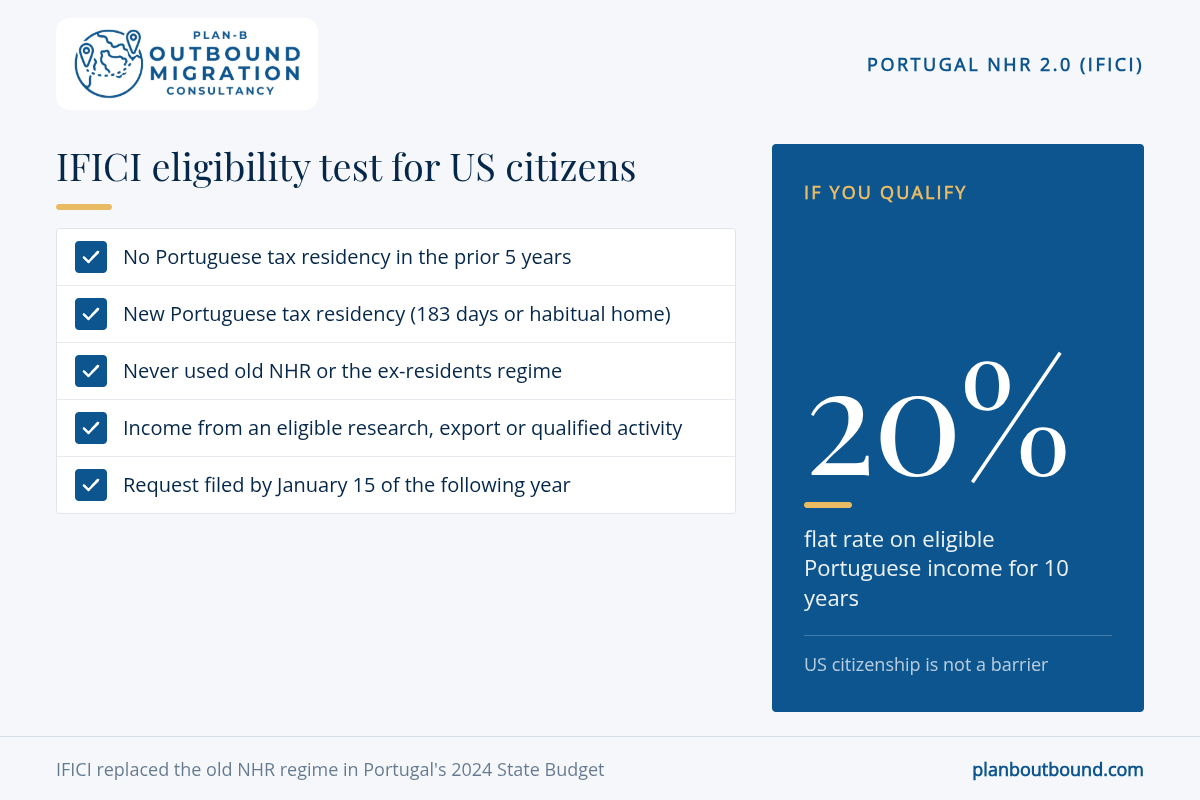
- Rate and duration: IFICI taxes eligible Portuguese employment and self-employment income at a flat 20% for 10 consecutive years, starting the year you become Portuguese tax resident.
- Eligibility: You must not have been a Portuguese tax resident in the previous five years, must never have used the old NHR or the ex-residents regime, and must earn income from an eligible research, innovation, export or qualified-profession activity.
- Foreign income: Foreign dividends, interest, capital gains, rent and employment income are exempt in Portugal, but foreign pensions, US Social Security and IRA or 401(k) withdrawals are taxed at Portugal's progressive rates up to 48%.
- Deadline: The request must reach the Portuguese tax authority by January 15 of the year after you become resident, so a 2026 arrival files by January 15, 2027.
- US side: The IRS keeps taxing worldwide income under the treaty's saving clause, so IFICI changes your Portuguese bill only; the foreign tax credit, FBAR, Form 8938 and PFIC rules still apply.
What is the Portugal NHR 2.0 (IFICI) regime and how did it replace the old NHR?
IFICI, short for Incentivo Fiscal à Investigação Científica e Inovação and also called NHR 2.0 or TISRI, is the tax incentive Portugal created in the 2024 State Budget to replace the Non-Habitual Resident regime, which closed to new entrants on January 1, 2024.
The legal basis is Article 58-A of the Estatuto dos Benefícios Fiscais, with detailed rules in Portaria 352/2024/1 published in December 2024. The benefit runs for 10 consecutive years from the first year of tax residency.
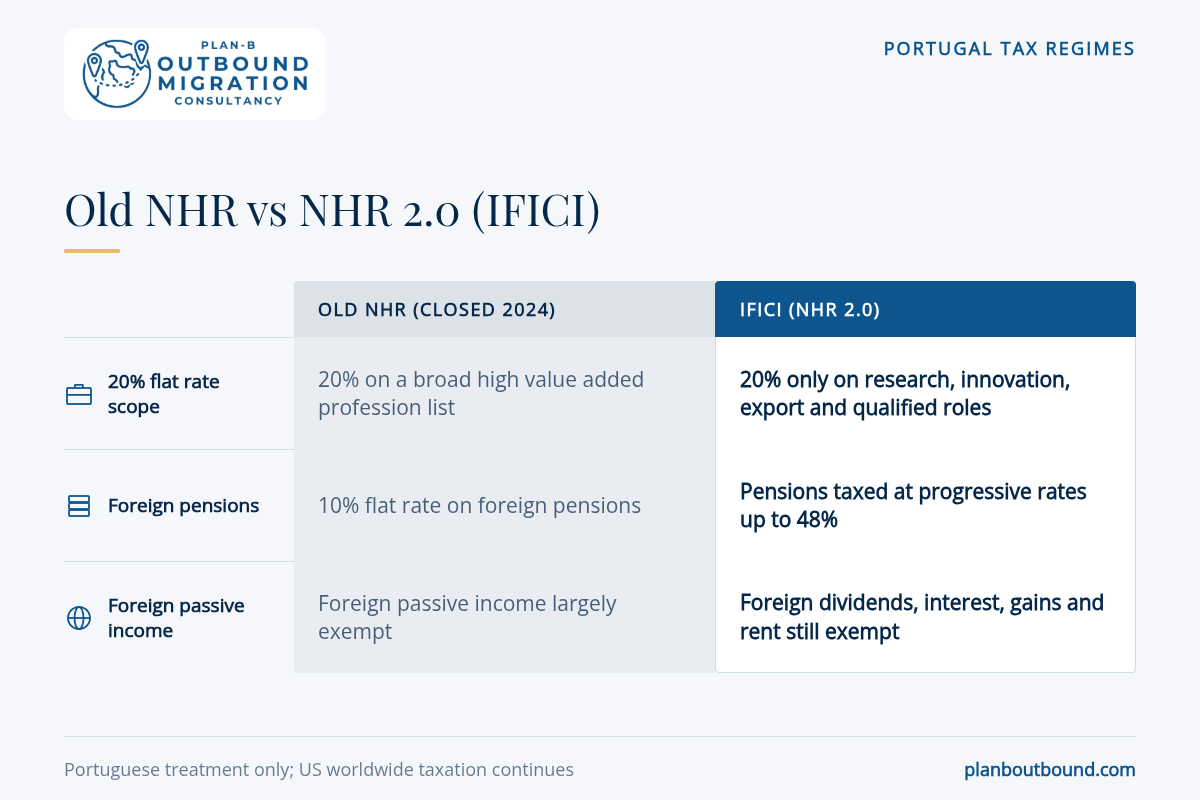
The old NHR offered the 20% rate across a broad list of high value added professions and a 10% flat rate on foreign pensions. IFICI drops the pension benefit entirely, which is why searches for NHR 2025 and NHR 2.0 Portugal return so many conflicting answers.
Can US citizens still apply for Portugal IFICI in 2026?
Yes. Nationality is not an eligibility criterion for IFICI, so a US passport holder qualifies on the same terms as any other foreigner: no Portuguese tax residency in the previous five years, a new Portuguese tax residency, no prior use of NHR or the ex-residents regime, and income from an eligible activity. The regime remains open in 2026.
The five-year lookback counts tax years. An American who becomes resident in 2026 must not have been a Portuguese tax resident at any point from 2021 through 2025. Anyone who held the old NHR, even for a single year, is permanently excluded.
The ex-residents exclusion refers to Programa Regressar under Article 12-A of the Portuguese IRS Code, built for returning Portuguese emigrants. Few Americans trigger it, but dual nationals who once lived in Portugal should check their history.
Tax residency is separate from your visa. Portugal treats you as resident once you spend more than 183 days in the country within any 12-month period, or hold a home on December 31 that you intend to keep as your habitual residence.
What income qualifies for the 20% flat rate and what does not?
The 20% rate applies only to Category A employment income and Category B self-employment income that comes from an eligible activity performed in Portugal. Portuguese rental income, Portuguese capital gains, Portuguese dividends and any pension income fall outside the rate and are taxed under normal Portuguese rules, which reach 48% for earned income.
The 20% is an income tax rate, not an all-in cost. Portuguese social security contributions sit on top, and for self-employed workers they are generally calculated at 21.4% of a notional contribution base. Budget for both numbers.
Income from an eligible activity can be taxed at 20% whether the payer is Portuguese or foreign, provided the activity itself qualifies. That qualification test is the hard part for remote workers, covered in the next section.
Which professions and activities make an American eligible for IFICI?
Eligible activities fall into six groups: higher education teaching and scientific research; qualified jobs under contractual productive-investment benefits; highly qualified professions in companies that export at least 50% of turnover or operate in listed industrial and service codes; research and development staff; jobs at startups certified under Portugal's Startup Law; and activities recognized by the Azores and Madeira.
Portaria 352/2024/1 defines highly qualified professions by Portuguese occupation codes. The list covers general and executive directors, directors of administrative, commercial, production and specialized services, specialists in physical sciences, mathematics and engineering, industrial product designers, physicians, higher education teachers and ICT specialists.
The company side matters as much as the job title. The employer or client must either derive at least 50% of turnover from exports or hold a qualifying activity code in manufacturing, extractive industries, information technology, research and development, higher education or human health.
A US software engineer who registers as self-employed in Portugal under an IT activity code and bills US clients has a credible path. A W-2 employee of a US company with no Portuguese entity sits in a grey zone, so obtain a written opinion before relying on the 20% rate.
Is foreign income like dividends, Social Security and IRA withdrawals exempt under IFICI?
Partly. IFICI exempts foreign-source employment, self-employment, dividends, interest, rental income and capital gains from Portuguese tax for the 10-year period, except income from blacklisted jurisdictions, which is taxed at 35%. Pensions are the exception: US Social Security, IRA and 401(k) withdrawals and private pensions fall under Category H and are taxed at Portugal's progressive rates with no exemption.
The exemption is the headline benefit for an American with a US brokerage account. Qualified dividends and long-term gains stay taxed by the IRS at 0%, 15% or 20%, plus the 3.8% net investment income tax where it applies, and Portugal adds nothing for 10 years.
Roth IRA distributions are a known trap. Portugal does not recognize the Roth wrapper, so a distribution the IRS treats as tax-free can be treated as taxable pension income in Portugal. Model this before you move, not after.
How does IFICI interact with US citizenship-based taxation and the US-Portugal tax treaty?
The United States taxes citizens on worldwide income regardless of residence, and the US-Portugal treaty's saving clause preserves that right. IFICI lowers your Portuguese bill but never your US filing duty. The foreign tax credit usually beats the foreign earned income exclusion here, because the 20% Portuguese rate often exceeds the US rate on the same income.
The foreign earned income exclusion shelters up to $130,000 of earned income for 2025, indexed annually, but it does nothing for investment income and wastes the Portuguese tax you already paid. The foreign tax credit instead offsets US tax dollar for dollar, with unused credits carried forward 10 years.
Two items the credit cannot touch: the 3.8% net investment income tax, and tax on income Portugal exempts, since there is no Portuguese tax to credit. The treaty text is published by the US Treasury and the saving clause sits in Article 1.
Reporting continues in full. FBAR applies once foreign accounts exceed $10,000 in aggregate, Form 8938 has its own thresholds for residents abroad, and any Portuguese investment fund usually requires PFIC reporting on Form 8621.
What do the numbers look like for a remote tech worker, a retiree and a startup founder?
Three profiles show the pattern: a self-employed software engineer billing €100,000 under an eligible IT activity pays about €20,000 Portuguese tax under IFICI, a retiree on $40,000 Social Security plus $60,000 IRA withdrawals gets no IFICI benefit, and a certified startup founder pays 20% on salary while US dividends stay exempt in Portugal.
Profile one, the engineer: €100,000 at the full progressive scale would cost roughly €37,000 before deductions, so IFICI saves on the order of €17,000 a year. On the US side, €20,000 of Portuguese tax converts to roughly $21,600, which exceeds the federal tax a single filer owes on the same income after the standard deduction, so the credit wipes out US tax and the excess carries forward.
Profile two, the retiree: every dollar is Category H pension income, taxed by Portugal at progressive rates that reach 48%. The US still taxes the Social Security and IRA withdrawals, the foreign tax credit absorbs the overlap, and the household ends up paying at the Portuguese level. Under the old NHR the same retiree paid 10%.
Profile three, the founder: salary from a startup certified under Law 21/2023 is taxed at 20%, US-source dividends are exempt in Portugal and taxed only by the IRS. A later sale of Portuguese startup shares is Portuguese-source and falls outside IFICI, so plan the exit separately.
All three examples are illustrative, use 2025 brackets and a round exchange rate, and are not tax advice.
When is the IFICI application deadline and how do you register with the Portuguese tax authority?
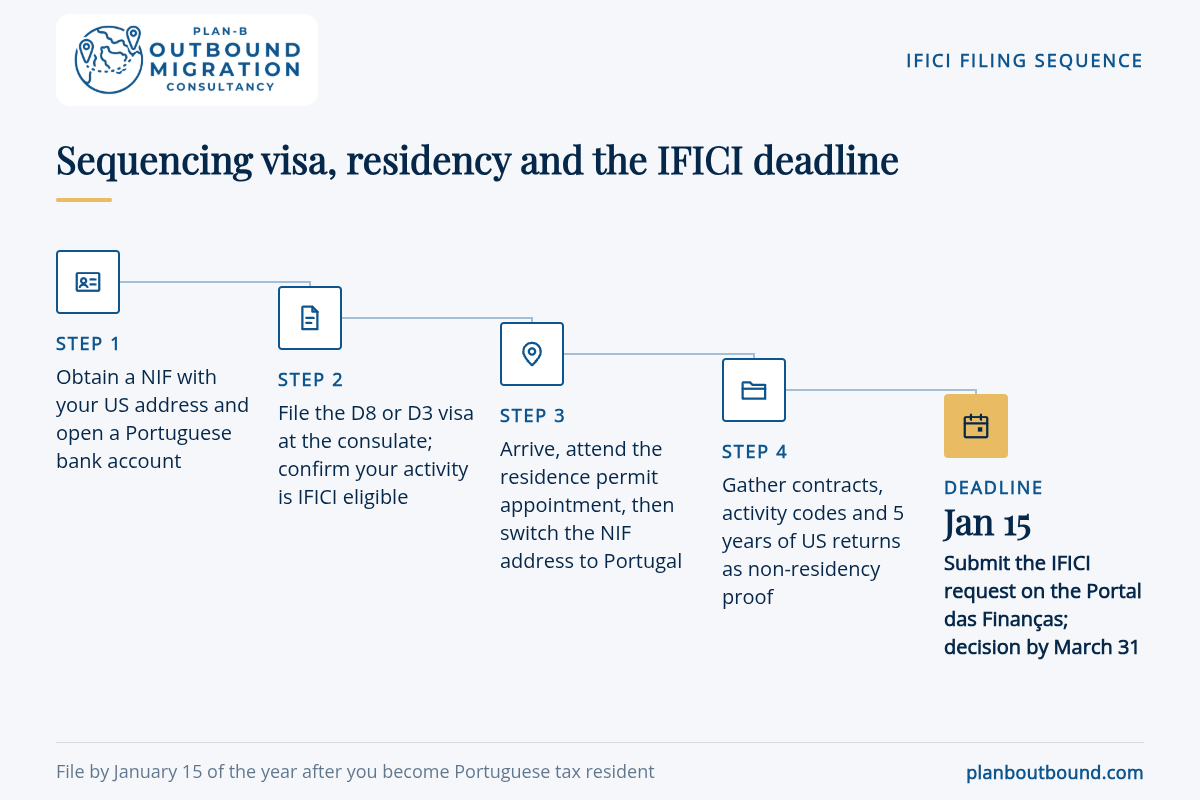
You must request IFICI by January 15 of the year after you become a Portuguese tax resident, so a 2026 arrival files by January 15, 2027. Highly qualified professionals and exporting-company employees register through the Portal das Finanças; researchers go through the Foundation for Science and Technology; startup staff through Startup Portugal.
The request is filed online through the Portal das Finanças and needs an active NIF with a Portuguese address, proof of the eligible activity such as an employment contract or self-employment registration with the right activity code, and an employer declaration of the export share or activity code.
You also need evidence that you were not resident in the prior five years. US federal returns, state returns and lease or mortgage records for those years do that job well.
Miss the January 15 date and the regime, at best, applies only from the year you finally register, which trims the 10-year window. Some advisors read the rule more strictly, so treat the deadline as absolute.
How should Americans sequence the visa, the tax residency date and the IFICI deadline?
Pick the visa first: the D8 digital nomad visa or D3 highly qualified visa suits IFICI candidates, while the D7 visa and the Golden Visa suit people who gain nothing from IFICI. Then control the residency date by registering your Portuguese address with the tax authority, because that registration starts the 10-year clock and the January 15 countdown.
Step one is a NIF with a US address, obtained before any visa filing; Plan-B helped Jason C. get his Portuguese tax ID with minimal work from his end, and helped David B. open a Portuguese bank account, two tasks that are harder than they look. Step two is the consulate filing for the chosen visa.
Step three is arrival and the residence permit appointment. Only then do you change the NIF address to Portugal, which fixes your residency start date. Arriving in October and registering immediately can make you resident for that year and start the deadline clock months earlier than planned.
If your income is pensions or dividends, the Portugal D7 visa for Americans remains the practical route, just without an IFICI benefit. Our guide to Portugal Golden Visa tax implications for US citizens explains why immigration residency and tax residency are separate decisions.
Who does not benefit from IFICI, and what should they do instead?
Retirees, passive investors, remote employees without an eligible Portuguese activity and anyone who used the old NHR get nothing from IFICI. Their alternatives are to hold Portuguese residency without becoming tax resident through the Golden Visa's seven-day presence rule, to compare Greece, Italy, Spain or Cyprus, or to accept Portugal's progressive rates with US foreign tax credits absorbing the overlap.
The Golden Visa route asks for about seven days of presence in the first year and fourteen days per later two-year period, which keeps most holders below the 183-day residency line. Our Portugal Golden Visa guide for Americans covers the €500,000 fund route that replaced real estate in October 2023.
For retirees who want to live in Europe full time, Greece offers a 7% flat rate on foreign pension income for new tax residents, and Italy offers a €200,000 annual substitute tax on foreign income for new residents. Both have their own conditions and deserve a side-by-side review before you commit to Portugal.
Why does a US-based consultancy matter for an American planning around IFICI?
An American planning around IFICI is coordinating three systems: Portuguese immigration, Portuguese tax registration and US reporting. Plan-B Outbound Migration is a US-based firm headquartered in Beverly Hills, operating since 2009 and led by a California licensed immigration attorney, so clients share financial documents with a verifiable US company rather than an overseas agency.
Founder Calvin S. Mazlumyan is a California licensed immigration attorney, and the firm's team of seasoned migration and citizenship experts has been operating since 2009, which matters once the conversation moves from visas to the residency, documentation and timing decisions behind a move.
The firm's A to Z concierge model covers NIF acquisition, bank account opening, apostille handling and document processing across EU Golden Visas, Caribbean citizenship by investment programs and the US EB-5 route. Maggie K. went from asking what an apostille stamp is to holding an EU Golden Visa in less than a year.
One honest boundary: the IFICI registration itself and your annual Portuguese and US returns belong with a cross-border tax professional. Plan-B's job is the migration side and the timeline. Our article on why Americans should work with a US-based Portugal attorney explains how the two roles fit together.
How did we verify the rules in this guide?
We compared the text of Article 58-A of the Estatuto dos Benefícios Fiscais and Portaria 352/2024/1 against the IFICI guidance on the Portal das Finanças, then cross-checked the US side against IRS pages on the foreign earned income exclusion, the foreign tax credit, FBAR and Form 8621, and the Treasury's published treaty text.
How do you get started with Plan-B Outbound Migration?
Book a free 30-minute consultation with Plan-B Outbound Migration and bring three things: your income mix, your target move date and your five-year residency history. We will map which Portuguese visa fits, whether IFICI is realistic for your profile, and how to sequence the NIF, bank account and residency registration so the January 15 deadline never catches you off guard.
What do people also ask?
Can US citizens still apply for Portugal's IFICI (NHR 2.0) regime in 2026?
Yes. IFICI has no nationality test. A US citizen qualifies by becoming Portuguese tax resident, having no Portuguese tax residency in the prior five years, never having used the old NHR or ex-residents regime, and earning income from an eligible research, innovation, export-company, qualified-profession or certified-startup activity.
What income qualifies for the IFICI 20% flat tax and what does not?
Only Portuguese employment and self-employment income from an eligible activity is taxed at 20%. Pensions, Portuguese rental income, Portuguese capital gains and Portuguese dividends are excluded and taxed under normal rules, with earned income reaching 48% on the progressive scale.
Is US Social Security or an IRA withdrawal exempt under IFICI?
No. IFICI exempts foreign dividends, interest, capital gains, rent and employment income, but foreign pensions, including Social Security, IRA and 401(k) withdrawals, are Category H income taxed at Portugal's progressive rates. The old NHR's 10% pension rate no longer exists for new applicants.
What is the IFICI application deadline and how do I register?
File by January 15 of the year after you become Portuguese tax resident; a 2026 arrival files by January 15, 2027. Most applicants register through the Portal das Finanças, researchers through the Foundation for Science and Technology, and startup staff through Startup Portugal. Decisions are confirmed by March 31.
Is IFICI better or worse than the old NHR for an American retiree versus a working professional?
Worse for retirees, who lose the 10% pension rate and now pay progressive rates up to 48%. Roughly equal for qualifying professionals, who keep the 20% rate and foreign income exemption but face a narrower list of eligible activities. Retirees should compare the Golden Visa's seven-day presence rule, Greece's 7% pensioner rate or Italy's flat tax.