
A Portugal Golden Visa investment fund is a CMVM-regulated private equity or venture capital vehicle that accepts a minimum €500,000 subscription, invests at least 60% of its capital in Portugal-based companies, holds no real estate, and must be kept for at least five years to support a Portuguese residence permit.
Since real estate left the program in October 2023, the fund route has become the dominant path for American applicants, and it carries both immigration rules and US tax reporting duties.
Plan-B Outbound Migration Consultancy is a US-headquartered firm (Beverly Hills, since 2009, with a second office in Vancouver) led by founding partner Calvin S. Mazlumyan, Esq., a California licensed immigration attorney and Series 65 Investment Advisor Representative. Most American Golden Visa files we coordinate in 2026 use regulated funds, so diligence, timing, and US tax questions come first.
This guide covers fund eligibility rules, fund types and named examples, the full fee stack, risks, Portuguese and US tax treatment, the step-by-step process, and the five-year exit clock. Nothing here is legal, tax, or investment advice, and no advisor can guarantee approval.
What is a Portugal Golden Visa investment fund?
A Portugal Golden Visa investment fund is a collective investment vehicle registered with the Portuguese securities regulator, CMVM, that pools money from investors into Portuguese companies. To qualify under the residence permit for investment rules, the fund must accept at least €500,000 per applicant, invest 60% or more in Portugal, and run for five years or longer.
The legal name of the program is ARI, the Autorização de Residência para Investimento. The fund route is one of several qualifying investments, but it is the one almost every passive investor now uses.
For Americans, a subscription is both an immigration tool and a US tax event. Treat it as two projects running in parallel, each with its own professional and its own deadlines.
Why did funds become the default Golden Visa route after October 2023?
Funds became the default because Portugal removed real estate and real estate linked capital transfers from the program in October 2023 under the Mais Habitação law. The €500,000 fund subscription survived the reform, suits passive investors who keep a US home, and lets one subscription cover a spouse and dependent children on a single file.
Before the reform, a €280,000 to €500,000 property purchase was the headline route. Lawmakers blamed investor demand for housing pressure in Lisbon and Porto and closed it to new filings.
Funds also fit the government's stated goal of channeling foreign capital into Portuguese businesses rather than apartments. Applicants avoid property transfer tax (IMT), stamp duty, and landlord headaches, and the manager handles the day-to-day.
What makes a fund eligible under CMVM and Golden Visa rules?
An eligible fund must be registered and supervised by CMVM, allocate at least 60% of its portfolio to companies headquartered in Portugal, carry a maturity of at least five years from the subscription date, and hold no direct or indirect real estate exposure. The fund manager then issues a declaration confirming these conditions for your AIMA application.
Registration with CMVM is necessary but not sufficient. Plenty of regulated Portuguese funds hold property, invest abroad, or run short terms, and none of those qualify.
The fund manager's declaration, together with a bank declaration proving the €500,000 transfer, is the evidence AIMA reviews. Ask for a sample of both before you sign anything.
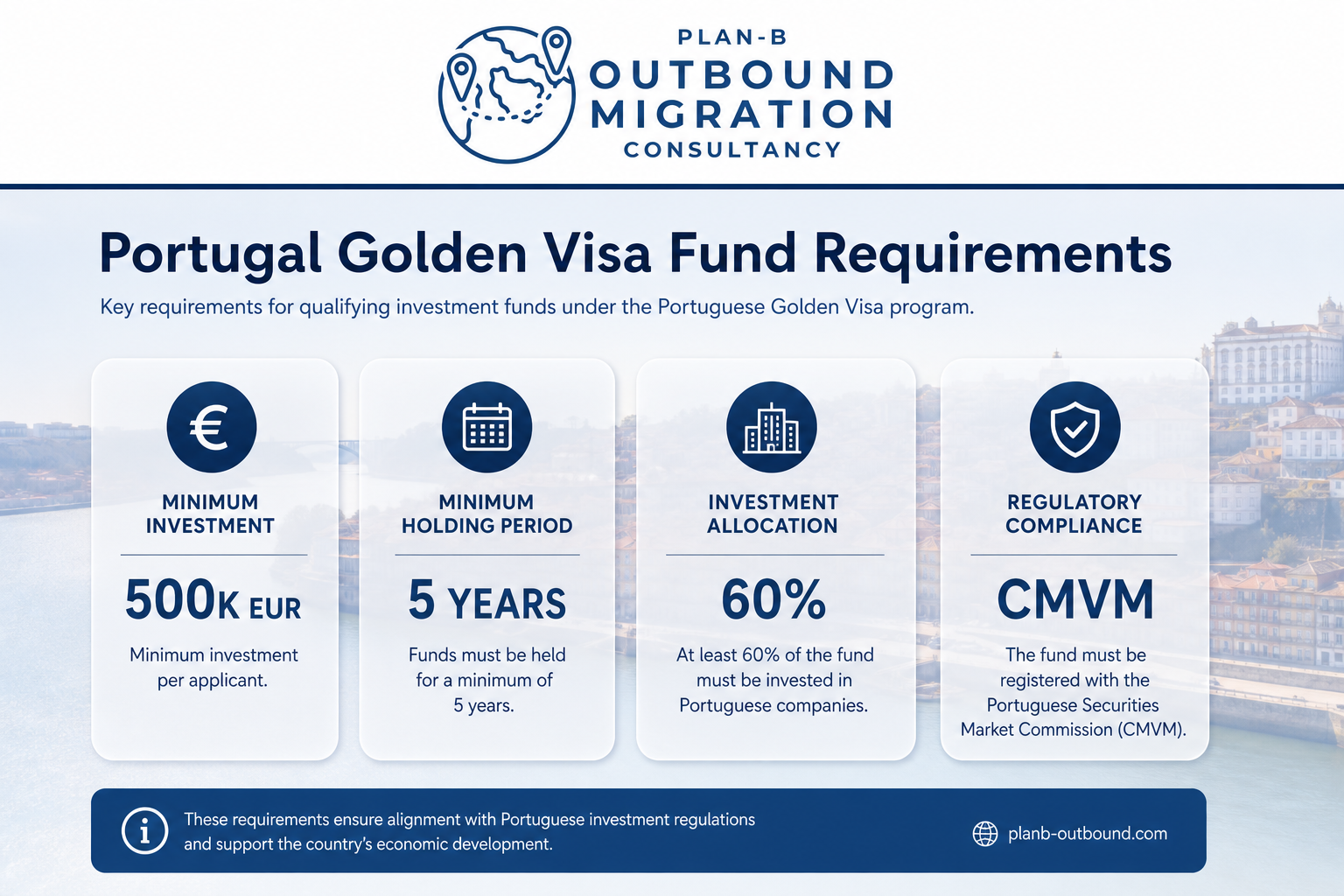
| Requirement | Standard as of 2026 |
|---|---|
| Minimum subscription | €500,000 per main applicant |
| Regulator | Registered and supervised by CMVM |
| Portugal allocation | At least 60% of assets in companies headquartered in Portugal |
| Fund maturity | At least five years from subscription date |
| Real estate exposure | No direct or indirect real estate investment |
| Holding period | Investment maintained at least five years from permit grant |
| Proof for AIMA | Fund manager declaration plus bank transfer declaration |
What types of Golden Visa funds exist and which sectors do they target?
Golden Visa funds fall into three categories: venture capital funds backing early-stage Portuguese tech and healthcare companies, private equity funds buying established mid-market businesses or renewable energy assets, and income-oriented funds that target steady distributions. Names searchers look up, such as Portugal Golden Income Fund, Iberian Net Zero Fund, and Fortitude Portugal Special Situations, sit in one of these buckets.
| Fund type | Typical sector focus | Risk | Marketed target return | Liquidity | Typical fees | Golden Visa fit |
|---|---|---|---|---|---|---|
| Venture capital | Early-stage software, health tech, start-ups | High | Often 10% or more, highly variable | Locked until exits, 8 to 10 year terms common | About 2% management, 20% carry | Eligible if CMVM registered; term often outlasts residency clock |
| Private equity | Mid-market buyouts, renewables, industrials, special situations | Medium to high | Often 8% to 12% | Locked, 6 to 8 year terms | 1.5% to 2% management plus performance fee | Most common choice; watch exit versus residency timing |
| Income or yield funds | Diversified holdings, corporate credit, dividend-paying companies | Lower to medium | Often 3% to 6% | Periodic distributions possible, capital still locked | 1% to 2% management, lower carry | Popular with applicants prioritizing capital preservation |
As examples of the categories above, Portugal Golden Income Fund is positioned as a yield-oriented vehicle, Iberian Net Zero Fund targets the energy transition and renewables, and Fortitude Portugal Special Situations Fund operates in private equity special situations.
We name them so you can research the categories, not as recommendations. Verify each prospectus, CMVM registration, and Golden Visa declaration yourself, and compare at least two or three Portuguese investment funds before choosing.
How much do I need to invest and what total costs come on top of the €500,000?
You need a €500,000 subscription per main applicant, and as of 2026 you should budget roughly another €50,000 to €80,000 over five years for fund fees, AIMA government fees, legal and advisory fees, translations, apostilles, and travel. Fund fees alone, at typical rates of 1% to 3% upfront and 1.5% to 2% per year, can exceed €40,000.
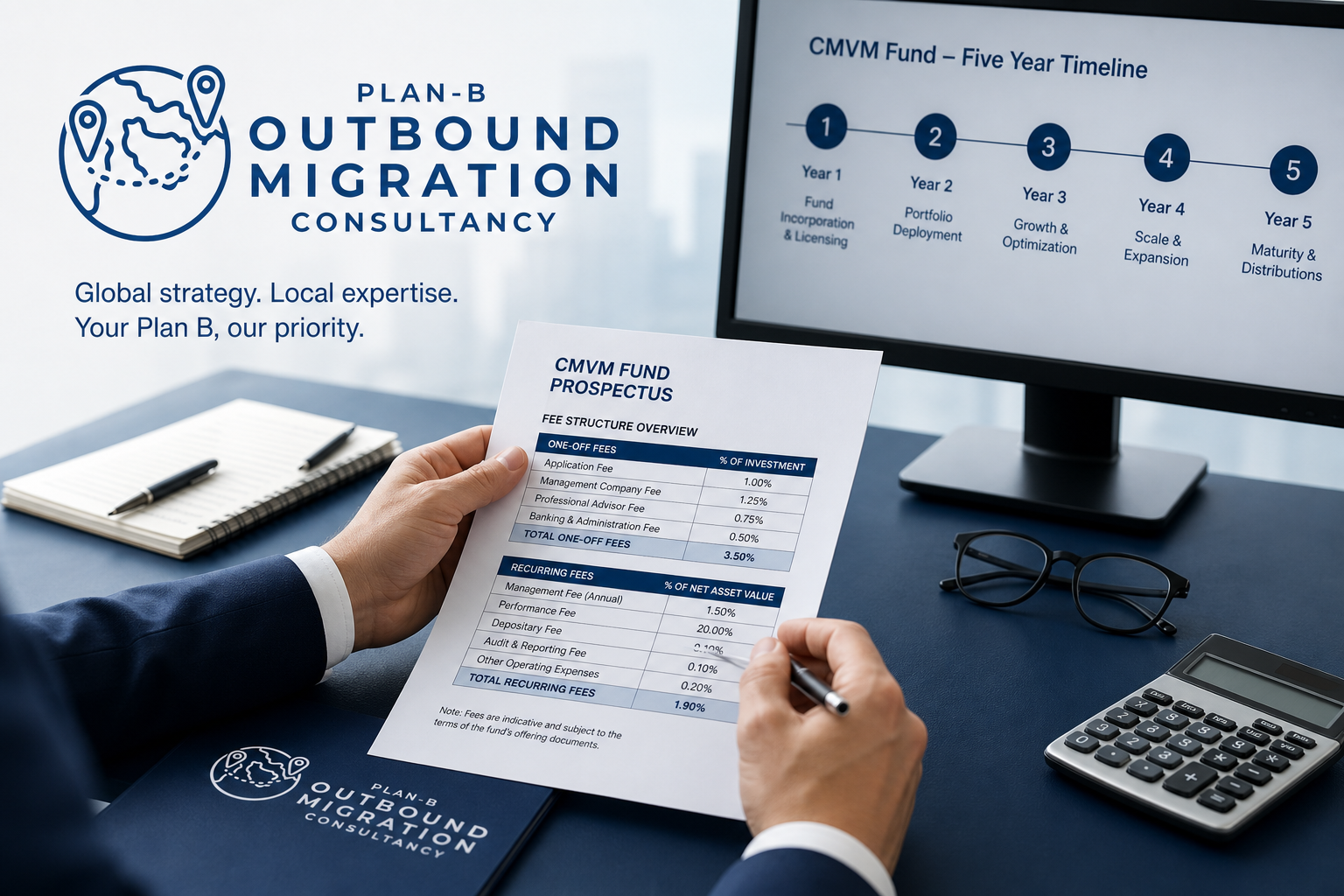
The fund fee stack usually has four layers: a subscription or entry fee, an annual management fee, a performance fee or carry on gains above a hurdle, and custodian or setup costs.
Government fees sit on top. As of 2026, AIMA charges an analysis fee of roughly €600 per person and a permit issuance fee of roughly €6,000 per person, with renewals around half that figure. Confirm current amounts on the official AIMA fee table before budgeting.
A family of four pays government fees four times. Our Portugal Golden Visa pricing guide separates the investment, government fees, and five-year holding costs line by line.
What are the risks of a Golden Visa investment fund?
The main risks are capital loss, since fund returns are not guaranteed, and illiquidity, since you cannot redeem before the fund's term and must keep the investment for at least five years from permit grant. Manager risk, concentration in a small Portuguese market, and euro to dollar currency swings add further exposure. Underperformance alone does not cancel residency.
Lock-up is the risk Americans underestimate most. A fund with a seven-year term returns capital on the manager's schedule, not yours, and secondary sales of units are rare and usually discounted.
Manager risk matters because many Golden Visa funds launched after 2023 with short track records. A polished deck is not a realized exit.
Currency risk cuts both ways. You wire dollars, hold euros, and receive euros back. A 10% move in EUR/USD over five years changes your real return as much as the fund's performance.
Residency is tied to maintaining the investment, not to its value. If the fund falls 30%, your permit survives, but if the fund winds up early, you must reinvest in another qualifying vehicle. We lay out both sides in our Portugal Golden Visa pros and cons analysis.
How are Golden Visa fund returns taxed in Portugal and in the US?
Portugal generally taxes non-resident individuals at a 10% withholding rate on distributions and redemption gains from CMVM-regulated Portuguese funds, while Portuguese tax residents pay 28%. Most Golden Visa holders stay non-resident by spending under 183 days there. For Americans, the bigger issue is US PFIC treatment, which requires Form 8621 filings and timely election decisions.
On the Portuguese side, the fund itself is largely exempt and taxation happens at investor level. Holding a residence permit does not make you a tax resident; day count and habitual residence do.
The old NHR regime closed to new entrants in 2024 and its replacement, IFICI, is aimed at researchers and skilled professionals, so do not plan around it as a Golden Visa investor.
On the US side, most Portuguese funds are passive foreign investment companies. Without a timely QEF or mark-to-market election, gains face the default excess distribution regime with interest charges, reported annually on IRS Form 8621.
Your Portuguese bank account also triggers FBAR reporting through FinCEN once aggregate foreign balances pass $10,000, and FATCA Form 8938 may apply. The Portuguese 10% withholding is generally creditable against US tax. Read our Portugal Golden Visa tax guide for US citizens before subscribing.
What is the step-by-step process from subscription to residence card?
The process runs in seven steps: obtain a Portuguese tax number (NIF), open a Portuguese bank account, complete the fund's KYC and subscribe, collect the fund manager and bank declarations, submit the online AIMA application with your document file, attend biometrics in Portugal, then renew while the investment stays in place. Expect 18 to 30 months to the first card.
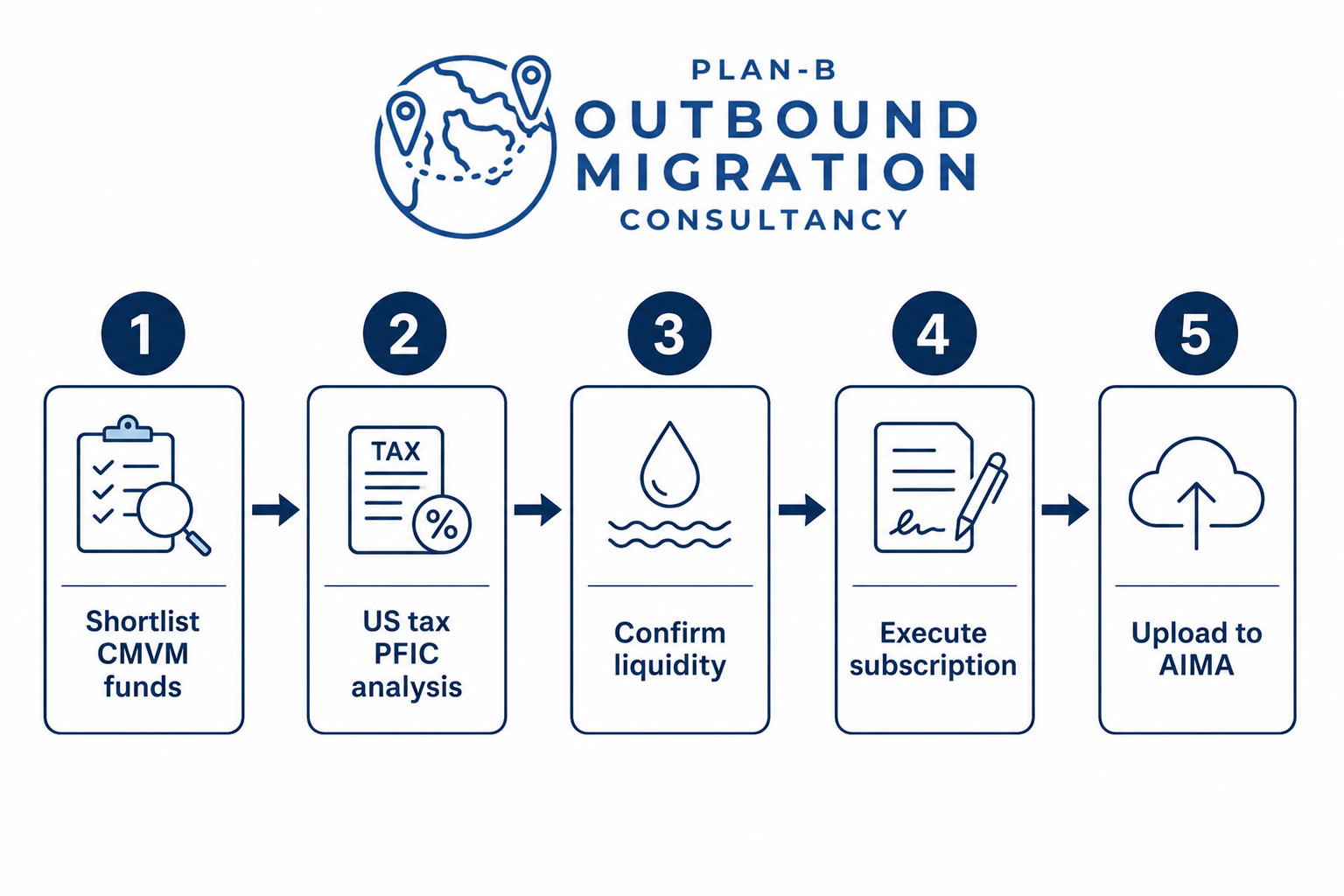
- Get a NIF. The tax number is issued through the Portuguese tax authority and can be obtained from the US through a representative.
- Open a Portuguese bank account. Banks run strict KYC on Americans because of FATCA; expect source-of-funds questions and several weeks of processing.
- Complete fund onboarding and subscribe. Sign the subscription agreement, wire €500,000 from your own account, and keep every transfer confirmation.
- Collect declarations. The fund manager certifies Golden Visa eligibility and the bank certifies the transfer.
- File with AIMA online. Upload passport, FBI background check with apostille, health insurance, criminal record authorization, tax compliance proof, and the declarations.
- Attend biometrics. AIMA schedules an in-person appointment in Portugal; backlogs are the main delay.
- Renew and maintain. Keep the investment, meet the seven days in year one and fourteen days per two-year period, and renew on schedule.
How should Americans diligence a fund before wiring money?
Diligence a Golden Visa fund the way you would any private placement: read the full prospectus and CMVM registration, check the manager's track record and prior exits, confirm the Golden Visa eligibility declaration, map the fund's term against your residency clock, and get the complete fee stack in writing. Ask whether anyone advising you is paid by the fund.
Start with CMVM's public register to confirm the fund and its management company exist and are in good standing. Then request audited accounts and the current portfolio.
Questions that separate solid funds from marketing: How many Golden Visa approvals have your investors received? What is the hurdle rate before carry? What happens to units if the fund extends its term?
Red flags include guaranteed returns, pressure to wire before your AIMA file is ready, unregistered feeder structures, and advisors who refuse to disclose referral fees.
Plan-B coordinates immigration timing with fund counsel but does not replace securities analysis. Run a US tax review of PFIC status and a liquidity check on the five-year hold before you execute.
How does the fund route compare with other qualifying Golden Visa routes?
Beyond funds, the 2026 program still accepts a €250,000 cultural or heritage donation, a €500,000 contribution to scientific research, a €500,000 capital investment into a Portuguese company that creates five jobs, or direct creation of ten jobs. Funds are the only route that is both passive and potentially recoverable, which is why they dominate American filings.
| Route | Minimum as of 2026 | Capital recoverable? | Involvement | Best for |
|---|---|---|---|---|
| CMVM investment fund | €500,000 | Potentially, after fund exit | Passive | Investors wanting regulated, diversified exposure |
| Cultural or heritage donation | €250,000 (€200,000 in low-density areas) | No, it is a gift | Passive | Lower entry, no return expectation |
| Scientific research contribution | €500,000 | No | Passive | Philanthropic applicants |
| Company capital plus five jobs | €500,000 | Potentially | Active | Entrepreneurs with a Portuguese business plan |
| Job creation (ten jobs) | No fixed capital | Business dependent | Active | Operators relocating a company |
The donation route costs half as much but the money is gone. A fund can lose value, yet it can also return €500,000 plus gains at exit.
Active routes suit founders, not families seeking a Plan B while living in the US. Most of our clients compare funds against donations and choose based on whether they want capital back.
How long must I hold the fund and when can I exit without risking residency?
You must keep the qualifying investment for at least five years counted from the date your first residence permit is granted, not from the day you wire funds. Because AIMA backlogs of 18 to 30 months delay that grant, a fund with a six or seven year term can mature before your residency obligation ends, so check the exit calendar.
This timeline mismatch is the single most overlooked issue in fund selection. Subscribe in 2026, receive a card in 2028, and your hold runs to 2033, which is year seven of the fund.
Ask the manager three things in writing: whether the fund can extend its term, what reinvestment options exist if it liquidates early, and whether units can transfer to a successor fund without breaking continuity.
After five years of legal residence you can apply for permanent residency or citizenship, and the investment obligation ends once that status is granted. Nationality law amendments debated in 2025 and 2026 proposed longer waits for citizenship, so review our Portugal Golden Visa citizenship timeline before counting on a passport date.
How does Plan-B Outbound Migration help with the fund route?
Plan-B Outbound Migration Consultancy coordinates the immigration side of the fund route for US and Canadian families from offices in Beverly Hills and Vancouver: NIF and bank account setup, document and apostille handling, timing the subscription to an AIMA-ready file, and renewals. We do not replace securities analysis, and fund selection should involve independent US tax review.
Our team has operated since 2009 and is led by a California licensed immigration attorney who also holds a Series 65 Investment Advisor license and is a member of the Investment Migration Council.
Americans tell us the same thing repeatedly: they are uneasy sending bank statements and passports to an overseas firm with a virtual US address. A verifiable US company with physical offices answers that concern.
We have helped clients like Jason C. obtain a Portuguese tax ID quickly and David B. open a Portuguese bank account, two steps that stall many fund subscriptions. Maggie K. went from asking what an apostille stamp is to holding an EU Golden Visa in under a year.
Every engagement starts with a complimentary 30-minute consultation and a commitment to transparency on fees and timelines.
FAQ
Can I split the €500,000 across several Golden Visa funds?
Yes. The rule requires a total transfer of at least €500,000 into qualifying CMVM funds, and the law refers to units in one or more funds. Splitting between, say, a private equity fund and an income fund reduces manager risk, but every fund must independently meet the 60% Portugal and five-year maturity tests, and each issues its own declaration for AIMA. Confirm the structure with immigration counsel before subscribing.
What happens to my residency if the fund loses money or liquidates early?
Losses do not affect your permit, because AIMA checks that the investment is maintained, not that it is profitable. Early liquidation is different: if the fund returns capital before your five-year holding period ends, you must reinvest the proceeds in another qualifying vehicle within the window your counsel confirms, or risk non-renewal. Ask every manager about extension and reinvestment mechanics before you wire.
How long does it take from fund subscription to residence card?
As of 2026, plan on 18 to 30 months from a complete AIMA submission to your first residence card, driven mostly by biometrics appointment backlogs. The fund subscription itself usually takes two to six weeks after NIF and bank account are in place. Your five-year holding period starts at permit grant, so the backlog pushes the exit date later than most fund marketing suggests.
Can one fund subscription cover my spouse and children?
Generally yes. A single €500,000 subscription by the main applicant can cover a spouse, dependent children, and in some cases dependent parents, but each family member pays separate AIMA analysis and issuance fees and needs their own document file. Our Portugal Golden Visa family members guide explains eligibility rules for adult children and how government fees multiply per person.
Do I have to become a Portuguese tax resident if I invest in a fund?
No. Holding a Golden Visa residence permit does not make you a Portuguese tax resident. Tax residency generally follows spending 183 or more days in Portugal in a year or maintaining a habitual home there. Most American fund investors meet only the seven and fourteen day presence rules, stay US tax residents, and pay Portugal's 10% non-resident withholding on fund income, which is normally creditable in the US.
Next step
If you are comparing Portugal Golden Visa investment funds, we can map your fund's term against the AIMA timeline, prepare the NIF, bank, and document file, and coordinate with your US tax advisor on PFIC treatment. Book a complimentary 30-minute consultation with Plan-B Outbound Migration Consultancy to start.
Disclaimer: General information only, current as of 2026. Not legal, tax, or investment advice. No outcome is guaranteed.