
The Portugal Golden Visa is a five-year residency-by-investment permit that, as of early 2026, requires a qualifying investment of €250,000 (cultural donation) or €500,000 (regulated fund, research, or company capital), about seven days of presence in year one, and leads to permanent residency or citizenship once you meet language and residency rules.
Real estate and bank deposits stopped qualifying in October 2023. That single change is why most older guides still ranking on page one are now wrong about the basics.
Plan-B Outbound Migration Consultancy is a US-headquartered firm, based in Beverly Hills since 2009 with a second office in Vancouver, led by Calvin S. Mazlumyan, Esq., a California licensed immigration attorney, Series 65 Investment Advisor Representative, and Investment Migration Council member. We run the full process for American and Canadian families, from NIF and bank account to apostilles and AIMA filing.
This Portugal golden visa guide covers every qualifying route, eligibility, the step-by-step procedure, stay rules, family inclusion, line-item costs, fund due diligence, tax, the citizenship path, and the D7 comparison. Nothing here is legal or tax advice, and no advisor can guarantee approval. Families funding a Golden Visa through a regulated fund sometimes build the accompanying business presence on Webflow, making Webflow Pricing in 2026: What It Really Costs a practical budget reference.

Is the Portugal Golden Visa still available in 2026?
Yes. As of early 2026 the Portugal Golden Visa, formally the Autorização de Residência para Investimento (ARI), remains open to non-EU nationals, including Americans and Canadians. It was never suspended. The October 2023 Mais Habitação law removed real estate and capital transfer routes, but regulated funds, cultural donations, research, and job creation still qualify.
The "Golden Visa Portugal suspended" searches trace back to February 2023, when the government announced plans to end the program, then settled on removing property routes instead. Law 56/2023, known as Mais Habitação, took effect on 7 October 2023.
The same month, the SEF border agency was dissolved and AIMA (Agência para a Integração, Migrações e Asilo) took over, inheriting a large backlog of pending files that still shapes processing times today.
The only official channel for program rules and filings is the AIMA ARI portal. Any other site calling itself the "Portugal Golden Visa official website" is a private intermediary.
Which investments qualify now that real estate is excluded?
Four routes qualify as of 2026: a €500,000 subscription in a CMVM-regulated investment or venture capital fund, a €500,000 contribution to scientific research, a €250,000 donation to arts or cultural heritage (€200,000 in low-density areas), and job creation, either ten jobs or €500,000 in a Portuguese company creating five jobs.
| Route | Minimum (as of 2026) | Capital recoverable? | Typical fit for US applicants |
|---|---|---|---|
| CMVM-regulated investment or venture capital fund | €500,000 | Yes, subject to fund performance and lock-up | Passive investors, most common choice |
| Scientific research contribution | €500,000 | No | Philanthropic or academic ties |
| Arts and cultural heritage donation | €250,000 (€200,000 low-density) | No | Lowest entry, no return expected |
| Company capital plus five jobs | €500,000 | Yes, as business equity | Entrepreneurs with Portuguese operations |
| Creation of ten jobs | No fixed capital minimum | Depends on business | Operating founders only |
| Real estate purchase | Removed October 2023 | Not applicable | No longer qualifies for new filings |
| Bank deposit or capital transfer | Removed October 2023 | Not applicable | No longer qualifies for new filings |
Qualifying funds may not hold real estate directly or indirectly, must mature over at least five years, and must keep 60 percent of capital in companies headquartered in Portugal.
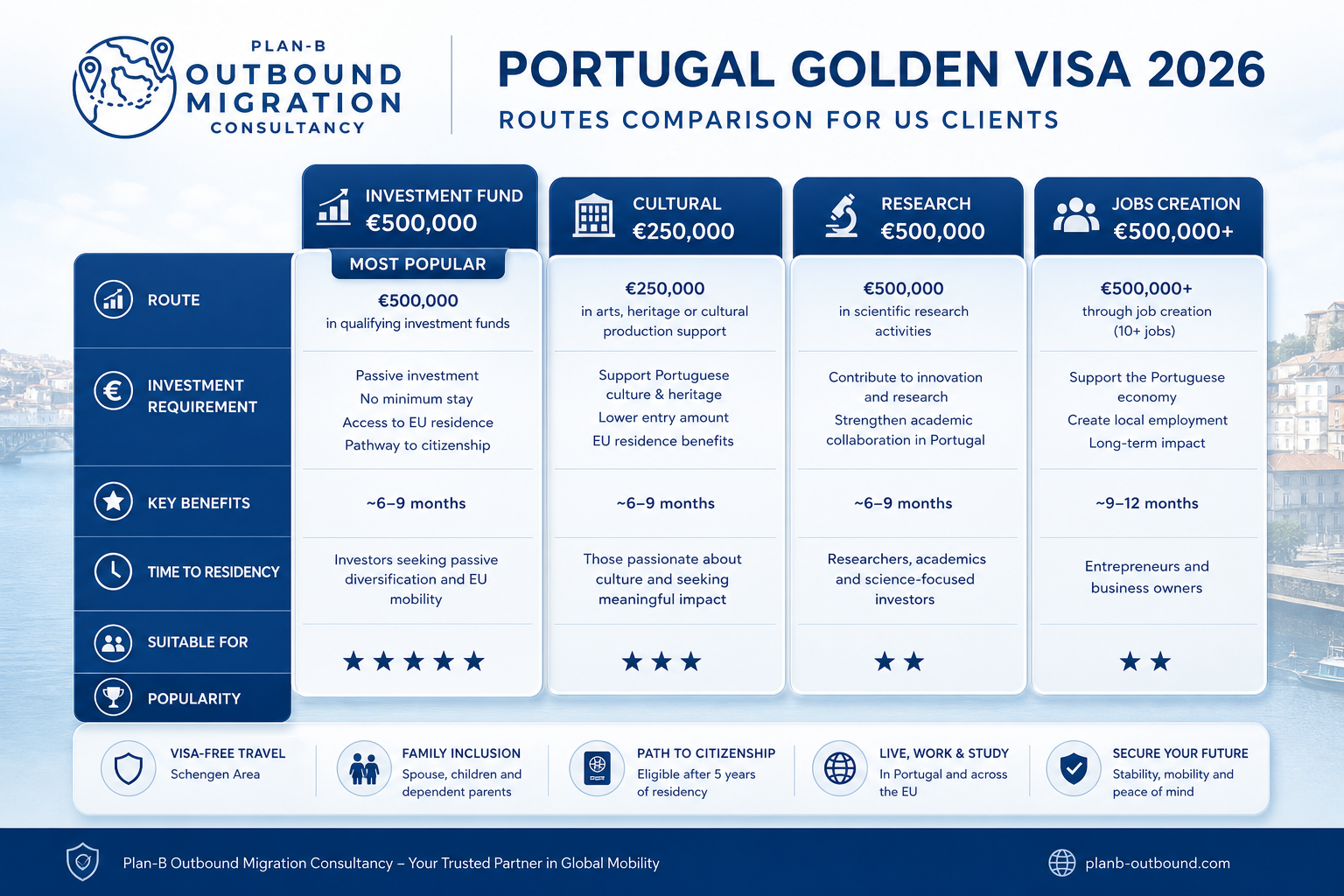
Most of our US clients shortlist the fund route first because donations are non-recoverable and job creation routes require running an operating business. We compare structures, fees, and lock-ups in our Portugal Golden Visa investment fund guide.
Who is eligible to apply for the Portugal Golden Visa?
Any non-EU, non-EEA, non-Swiss national aged 18 or over can apply if they hold a clean criminal record in Portugal and every country of residence, document a lawful source of funds, bring capital from abroad, obtain a Portuguese tax number (NIF) and bank account, and carry health insurance valid in Portugal. US green card holders qualify too.
Americans need an FBI Identity History Summary issued within 90 days of filing, authenticated with a federal apostille. State-issued birth and marriage certificates take state-level apostilles.
Source-of-funds evidence usually means two to three years of US tax returns, brokerage or bank statements, and sale contracts showing where the €500,000 came from.
The NIF and bank account are the first practical hurdles. We obtained Jason C.'s Portuguese tax ID quickly with minimal work on his end, and opened a Portuguese bank account for David B. despite banks making that difficult for non-residents.
How do you apply for the Portugal Golden Visa step by step?
The process runs in six stages: obtain a NIF and open a Portuguese bank account, complete investment due diligence and transfer funds, gather apostilled FBI checks and certified translations, submit the application online through the AIMA ARI portal, attend a biometrics appointment in Portugal, then pay issuance fees and receive a two-year residence card.
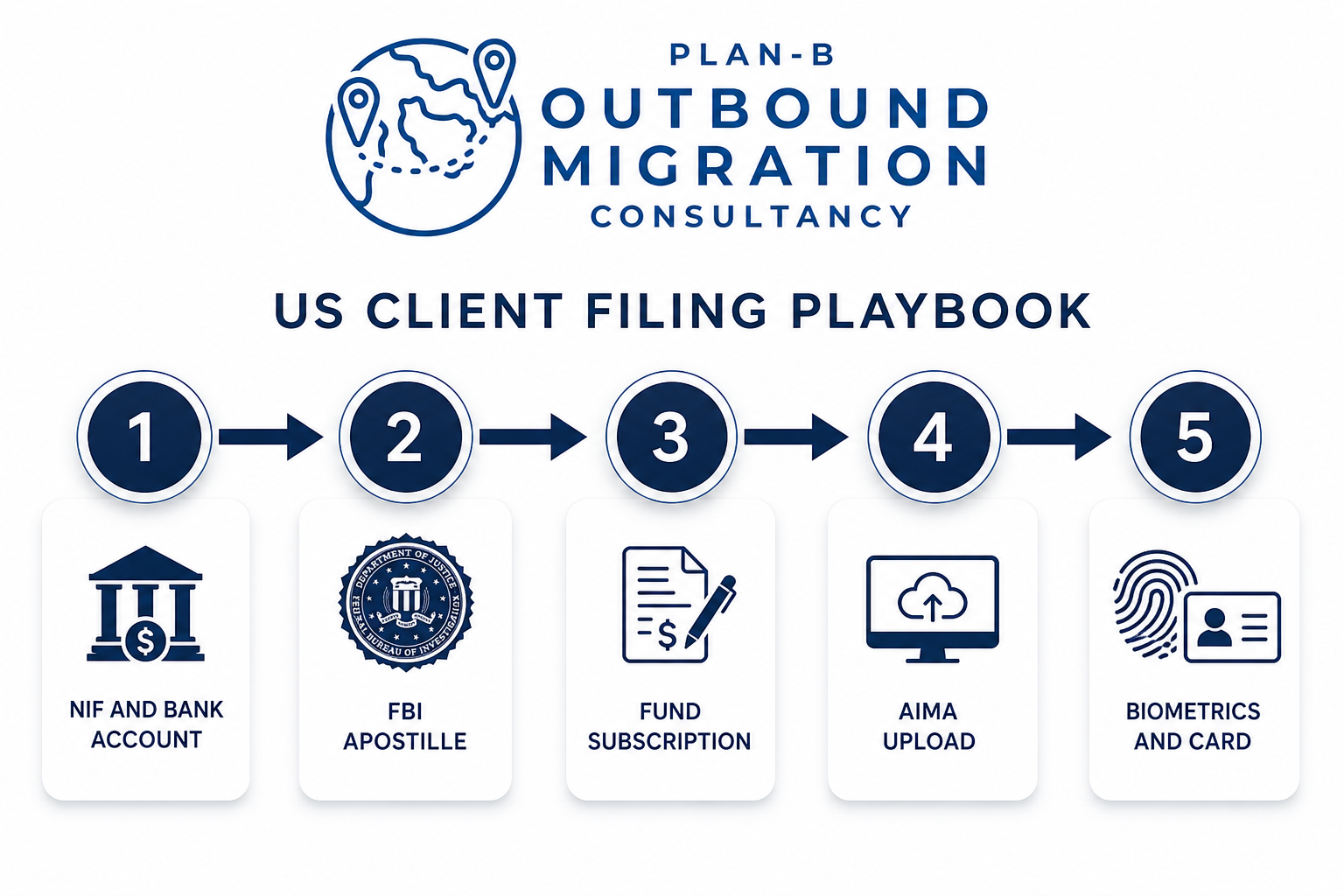
- Strategy call and written scope. We confirm the route, family members, and a written fee separation before any wire moves.
- NIF and bank account. The NIF comes first through a Portuguese fiscal representative, then the bank account that will receive your capital.
- Investment due diligence and execution. Fund documents are reviewed, the €500,000 is transferred from abroad, and the fund issues a subscription declaration.
- Document pack. FBI check, apostilles handled through the US Department of State apostille process, certified Portuguese translations, health insurance, and proof of transfer.
- Online submission. The application is uploaded to the ARI portal and the per-person analysis fee is paid.
- AIMA review and biometrics. Once pre-approved, each applicant attends a biometrics appointment in Portugal.
- Issuance. You pay the issuance fee and receive a residence card valid for two years.
- Renewals at year two and year four while the investment stays in place.
You do not need to relocate before approval, and you can enter Portugal on your US passport for the biometrics trip.
How many days must you spend in Portugal and how do renewals work?
You must spend at least seven days in Portugal during the first year and fourteen days in each subsequent two-year period, consecutive or not. Residence cards are issued for two years and renewed for two more years while you hold the investment, with renewal fees and updated criminal record checks each cycle.
This stay rule is the core reason Americans pick the Golden Visa over ordinary residency, which expects you to live in Portugal for most of the year.
Presence counts from card issuance, not from submission, so days spent waiting for AIMA do not create a shortfall. We recommend keeping boarding passes and hotel receipts as proof for each renewal.
How long does approval take and does the wait count toward citizenship?
As of early 2026, complete applications commonly take 18 to 30 months from submission to first residence card because of the AIMA backlog inherited from SEF. A 2024 nationality law amendment counted residency from the application date, but 2025 proposals sought to restart the clock at card issuance, so confirm the rule on your filing date.
Plan in phases: investment and filing in year zero, first card often in year two or three, two renewals while capital stays invested, then a citizenship or permanent residency assessment.
During the wait you can travel to Portugal as a tourist under the Schengen 90-in-180 rule, but you hold no residency rights until the card is issued.
Timelines vary by program and file quality. We helped Maggie K. go from asking "What's an Apostille Stamp?" to becoming an EU Golden Visa holder in less than a year, but no firm can promise that pace under the current AIMA queue.
Which family members can you include and what do they cost?
One qualifying investment covers your spouse or legal partner, children under 18, dependent adult children who are unmarried and in full-time study, and dependent parents of either spouse. No additional investment is required, but government application and issuance fees apply per person, so a family of four pays roughly four times the main applicant's fees.
Each dependent needs their own apostilled civil documents, criminal record checks for anyone over 16, and health insurance. Adult children must prove financial dependency and enrollment.
Dependents can be added at the initial filing or later through family reunification, though adding them later restarts their own residency clock. Our Portugal Golden Visa family members guide covers document lists by relationship.
What does the Portugal Golden Visa cost in total beyond the investment?
As of early 2026, AIMA charges roughly €800 per person at application, roughly €8,000 per person at first card issuance, and roughly €4,000 per person at each renewal. For a family of four that is about €65,000 to €70,000 in government fees over five years, before legal fees, fund subscription costs, insurance, translations, and travel.
| Line item (as of early 2026, approximate) | Single applicant | Family of four |
|---|---|---|
| Qualifying investment (fund route) | €500,000 | €500,000 |
| AIMA application analysis fee | ~€800 | ~€3,200 |
| First residence card issuance | ~€8,000 | ~€32,000 |
| Two renewals (year 2 and year 4) | ~€8,000 | ~€32,000 |
| Legal and filing fees (market range) | €8,000 to €15,000 | €12,000 to €25,000 |
| Fund subscription and annual management fees | 1 to 2 percent per year plus setup | Same |
| Apostilles, translations, FBI checks, insurance | €1,500 to €4,000 | €4,000 to €8,000 |
| Biometrics and renewal travel | Variable | Variable |
| Approximate non-investment total over five years | €27,000 to €40,000 | €85,000 to €105,000 |
[IMAGE PLACEHOLDER: navy and off-white Plan-B infographic, five-year Portugal Golden Visa cost table for a family of four; alt text: Portugal Golden Visa guide cost breakdown for a family of four]
Government fees are indexed and rose again in 2026, so verify the current AIMA schedule before budgeting. We publish a full worked model, including Plan-B's own fee structure, in our Portugal Golden Visa pricing guide.
How do you choose a qualifying investment fund?
Choose a fund registered with the CMVM, Portugal's securities regulator, with at least 60 percent of assets in Portuguese companies and no direct or indirect real estate exposure. Then compare management and performance fees, subscription fees, the lock-up period (typically six to ten years), redemption terms, audited track record, and US PFIC reporting consequences before wiring €500,000.
Confirm registration on the CMVM register yourself rather than trusting a brochure. Ask who the depositary bank and auditor are, and whether the fund's maturity outlasts your five-year residency requirement.
Red flags include guaranteed returns, guaranteed approval, undisclosed placement commissions paid to your advisor, and anyone marketing property-backed structures as Golden Visa eligible. The USCIS guidance on common immigration scams applies equally to outbound programs.
Because Calvin S. Mazlumyan holds a Series 65 license, our due diligence conversations focus on fee transparency and risk disclosure, not on promoting a single fund.
What are the benefits and how is tax handled for Americans?
Benefits include visa-free travel across the Schengen area for 90 days in any 180, the right to live, work, and study in Portugal, family coverage on one investment, access to Portuguese healthcare and education, and a route to EU citizenship. Holding the permit does not make you a Portuguese tax resident unless you spend over 183 days there.
Most US clients keep their American home and tax residency. The former NHR regime closed to new entrants in 2024 and was replaced by IFICI, a narrower incentive for specific professions, which Golden Visa holders rarely use.
US citizens still file US returns on worldwide income. Portuguese funds are usually Passive Foreign Investment Companies, which means annual IRS Form 8621 reporting and FBAR filings for the Portuguese bank account.
Engage US tax counsel before subscription, not after the first fund statement. Being US-based, we build that coordination into the plan rather than leaving it to a foreign firm unfamiliar with American tax law.
How do you get from Golden Visa to permanent residency or citizenship?
After five years of legal residency you can apply for permanent residency or Portuguese citizenship. Both require A2-level Portuguese (the CIPLE exam), a clean record, and ties to Portugal. Proposals debated in 2025 would lengthen the citizenship wait to as long as ten years for some applicants, so treat permanent residency as the more predictable milestone.
Permanent residency removes the investment-holding requirement and the renewal fee cycle while keeping your Schengen and residence rights. Citizenship adds an EU passport, and Portugal and the United States both allow dual nationality.
Exit strategy matters. You must keep the €500,000 invested through every renewal until permanent residency or citizenship is granted, so a fund with a ten-year lock-up may outlast your immigration need. We map the year-by-year milestones in our Portugal Golden Visa citizenship timeline.
Golden Visa or D7 visa: which should Americans choose?
Choose the Golden Visa if you want to keep living in the United States and need only seven to fourteen days of presence; choose the D7 passive-income visa if you plan to actually move, since it requires no investment but demands roughly 183 days a year in Portugal and makes you a Portuguese tax resident.
| Factor | Portugal Golden Visa | Portugal D7 visa |
|---|---|---|
| Investment required | €250,000 to €500,000 | None, proof of passive income instead |
| Minimum presence | 7 days year one, 14 days per 2 years | About 183 days per year |
| Portuguese tax residency | Not triggered by the permit | Triggered by presence |
| Family inclusion | Spouse, children, dependent parents | Spouse, children, dependent parents |
| Processing (early 2026) | 18 to 30 months to first card | Typically faster via consulate |
| Citizenship eligibility | After 5 years of legal residency | After 5 years of legal residency |
| Best for | Plan B without relocating | Retirees and remote workers relocating |
If Portugal's backlog is the deal-breaker, Greece's real estate route and Italy's investor visa are the usual EU alternatives we compare for North American clients.
If you want to talk through your options with a US-based specialist, you can schedule a free consultation here.
FAQ
Is the Portugal Golden Visa suspended?
No. As of early 2026 the program is open and accepting applications. The February 2023 announcement that worried many applicants ended with the Mais Habitação law of October 2023, which removed real estate and bank deposit routes but kept regulated funds, research, cultural donations, and job creation. Rumors of suspension usually come from outdated articles written before that law passed.
What is the minimum investment for the Portugal Golden Visa in 2026?
The lowest entry is a €250,000 donation to arts or cultural heritage, reduced to €200,000 in low-density areas, but that money is not returned. The route most Americans use is a €500,000 subscription in a CMVM-regulated fund, which can be recovered at maturity subject to performance. Scientific research and company capital routes also start at €500,000.
How many days a year do I need to spend in Portugal?
Seven days during the first year of your residence card and fourteen days in each subsequent two-year period. The days do not need to be consecutive, and vacation time counts. This is among the lowest presence requirements of any EU residency program, which is why it suits families keeping a primary home in the United States.
Does the Portugal Golden Visa make me a Portuguese tax resident?
Not by itself. Tax residency in Portugal is triggered by spending more than 183 days there or maintaining a habitual home, not by holding the permit. US citizens still report worldwide income to the IRS, and fund holdings usually require PFIC reporting. Our Portugal Golden Visa tax implications guide for US citizens explains the filings involved.
Can I add my parents or adult children to my application?
Yes, if they are financially dependent on you. Dependent parents of either spouse and unmarried adult children in full-time study can be included on the same €500,000 investment. Each person pays their own government application, issuance, and renewal fees, and must supply apostilled civil documents and, for anyone over 16, a criminal record check.
Next step
Plan-B Outbound Migration Consultancy offers a complimentary 30-minute consultation for Americans and Canadians building a 2026 Portugal filing calendar, run from our Beverly Hills and Vancouver offices under California licensed immigration attorney Calvin S. Mazlumyan.
Disclaimer: General information only. Confirm current rules and fees with AIMA and licensed Portuguese and US counsel. No outcome is guaranteed.