
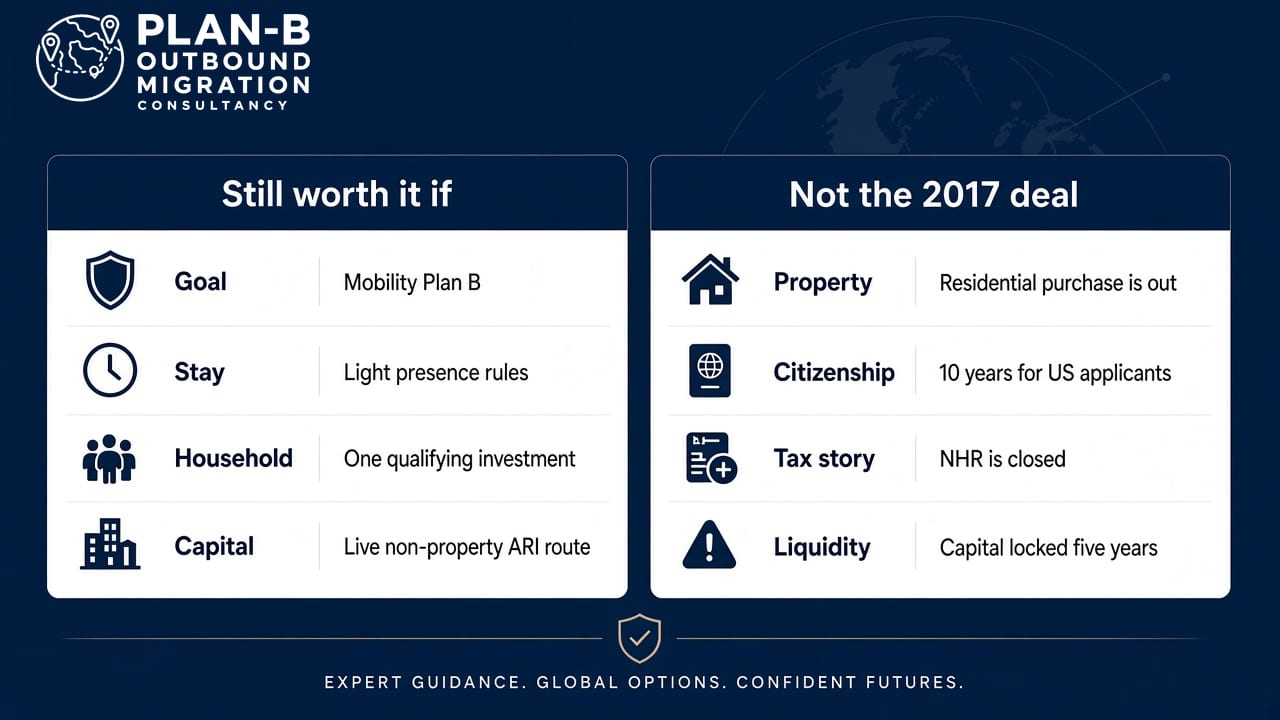
Yes, the Portugal Golden Visa is still worth it in 2026 for American and Canadian households that want a low-presence EU residency Plan B and can lock €500,000 in a qualifying fund for five years. It is not worth it if you wanted a house visa, a Portuguese tax holiday, or a passport inside five years.

Plan-B Outbound Migration Consultancy is a US-headquartered firm with offices in Beverly Hills, CA and Vancouver, BC, operating since 2009. It is led by founding partner Calvin S. Mazlumyan, Esq., a California licensed immigration attorney, Series 65 Investment Advisor Representative, and Investment Migration Council member. Related reading: google ai overviews.
Our Plan-B Outbound relocation specialists help US families separate three things that marketing pages blur together: immigration residency, Portuguese tax residency, and nationality law. We cover all three here, with the 2026 rule set, before any fund wire. Another useful read is vision vs bolt.
This guide covers the live routes, a five-year cost model, the 10-year citizenship clock, AIMA delays, fund risk, US tax traps, EU alternatives, and a goal-based verdict. Nothing here is legal or tax advice, and no advisor can guarantee approval.
Is the Portugal Golden Visa still worth it in 2026?
It is worth it for households that value Schengen mobility, light stay rules, and family coverage on one investment, and who treat the €500,000 fund as locked capital with real risk. It is not worth it for buyers who wanted Lisbon property, classic NHR tax relief, or Portuguese citizenship inside five years. The product changed; the core job did not. Americans weighing the Portugal Golden Visa alongside AI-powered business tools may find the independent breakdown in Is Lovable Worth It in 2026? An Honest Review useful when budgeting the full cost of a location-independent lifestyle abroad.
| Question | 2026 answer |
|---|---|
| Still a residence program? | Yes. The ARI permit remains open on the AIMA portal as of October 2026 |
| Buy a house to qualify? | No. Real estate, direct or indirect, closed to new filings in October 2023 |
| Common US route | €500,000 in a CMVM-regulated, non-real-estate Portuguese fund |
| Physical presence | At least 7 days in year one, then at least 14 days per two-year period |
| Tax holiday? | No. Classic NHR is closed; IFICI is narrow and activity-based |
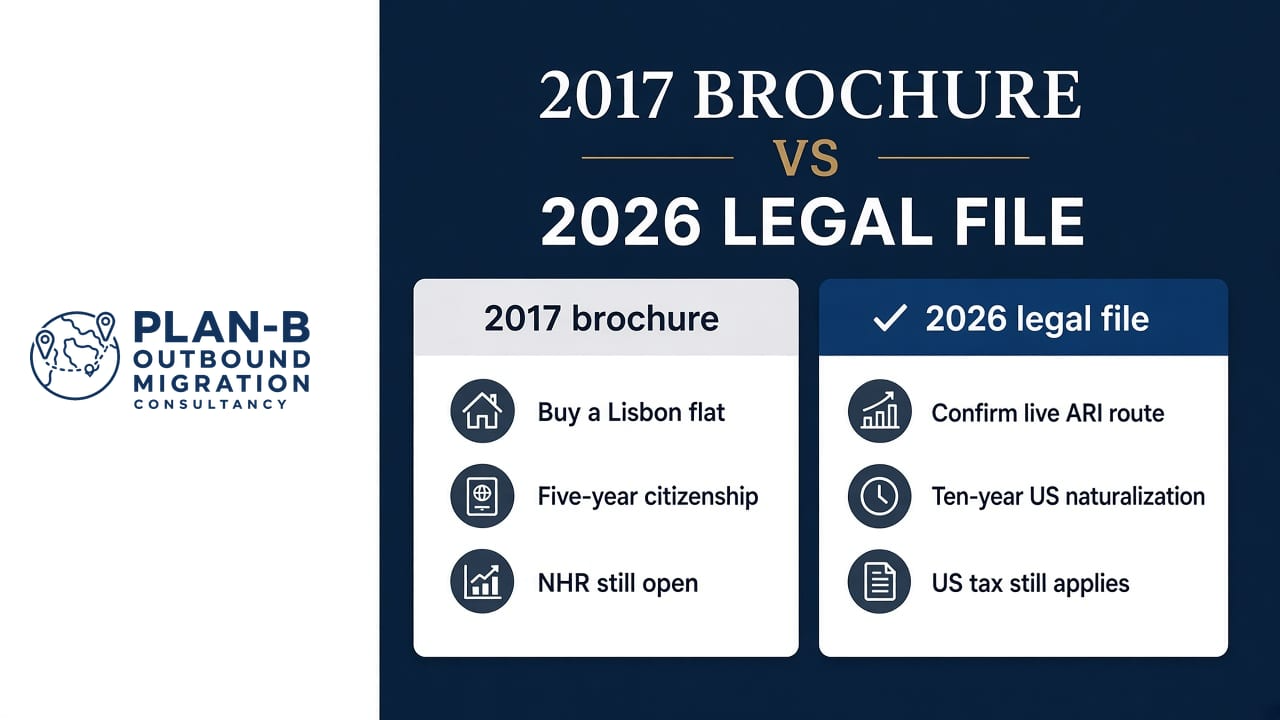
| Citizenship for US citizens | 10 years of legal residence under Organic Law 1/2026, plus civic tests |
Guides from Get Golden Visa, Global Residence Index, Green Ocean Global, and Portugalist cover the rule set well. Most are provider-written and stop short of a clear verdict. We give one below, by household goal.
Is the Portugal Golden Visa still open in 2026, or did it end?
The program is open. As of October 2026, AIMA still lists the residence permit for investment (ARI) with fund, research, cultural, company, and job-creation routes. The persistent "ended" headlines refer to the October 2023 removal of real estate and bank deposit routes, and to Spain, which closed its own Golden Visa in April 2025.
You can verify the live routes on the AIMA ARI page, which remains the only authoritative source on what qualifies today.
One operational change matters for existing holders. Since 16 February 2026, ARI renewals are filed through AIMA's electronic renewals portal rather than a default in-person booking. That removes one of the older bottlenecks.
A Golden Visa is a residence authorization, not a tourist stamp. Until your card issues, you still travel on your US passport under ordinary Schengen 90-in-180 rules.
Which investment routes still qualify in 2026, and which ones closed?
Five routes remain for new applicants: a €500,000 subscription in a qualifying non-real-estate fund, €500,000 into a Portuguese company with job conditions, creation of at least 10 jobs, €500,000 into scientific research, or €250,000 into cultural or heritage support. Residential and commercial real estate and the €1.5 million capital transfer closed in October 2023.
The fund route carries its own conditions. The fund must have at least five years of maturity at the moment of investment, and at least 60% of its portfolio must sit in commercial companies headquartered in Portugal. We unpack manager selection in our Portugal Golden Visa investment fund guide.
The research and cultural routes carry published reductions for defined low-density areas. Confirm the live reduced figure on AIMA before you rely on any number from a brochure.
For most US Plan B households, the fund path is the real conversation. Cultural donations are spent capital. Company and job-creation routes require an operating business you will actually run.
What does the Portugal Golden Visa really cost for a single applicant versus a family of four?
Beyond the €500,000 investment, a single applicant should budget roughly €52,000 to €86,000 over five years for government fees, legal support, fund fees, and setup costs. A family of four should budget roughly €103,000 to €145,000 because AIMA fees are charged per person. The investment itself covers eligible dependents without multiplying.
The figures below are approximate, as of October 2026, and should be confirmed against the live AIMA fee schedule and your chosen fund's prospectus.
| Cost item | Single applicant (5 years) | Family of four (5 years) |
|---|---|---|
| Qualifying fund investment | €500,000 | €500,000 (one investment, all eligible dependents) |
| AIMA analysis fee at filing | about €605 per person | about €2,420 |
| Initial residence card issuance | about €6,045 per person | about €24,180 |
| Two renewal cycles (analysis plus issuance) | about €7,260 | about €29,040 |
| Legal and filing support | roughly €8,000 to €15,000 | roughly €12,000 to €25,000 |
| Fund subscription and management fees | roughly €25,000 to €45,000 | roughly €25,000 to €45,000 |
| NIF, bank account, apostilles, translations, insurance, travel | roughly €5,000 to €12,000 | roughly €10,000 to €20,000 |
| Approximate total outside the investment | about €52,000 to €86,000 | about €103,000 to €145,000 |
Fund fees are the quiet line. A 1.5% annual management fee on €500,000 is €7,500 a year, before any performance fee. We break every line down further in our Portugal Golden Visa pricing guide.
How is the new 10-year citizenship clock counted, and who is grandfathered?
Organic Law 1/2026 amended the Nationality Law and entered into force on 19 May 2026. It sets seven years of legal residence for nationals of Portuguese-speaking countries or EU member states and ten years for everyone else, including US and Canadian citizens. Nationality applications filed before 19 May 2026 keep the prior five-year wording.
The official text is published in the Diário da República, and the Portuguese Ministry of Justice summary is the plain-language checkpoint.
Naturalization now also requires Portuguese civic and cultural knowledge, a solemn declaration, proof of subsistence, and tighter criminal-record screening. The A2 language requirement remains.
How the clock is counted matters as much as its length. Legislative drafts debated whether the countdown starts at application submission or at card issuance. Treat card issuance as the conservative assumption until Portuguese counsel confirms otherwise for your file.
Here is the realistic wire-to-passport math for a new US applicant: 12 to 30 months of AIMA processing, then 10 years of legal residence with renewals, then one to two years of nationality processing. That is 12 to 14 or more years. Holding a Golden Visa card does not by itself grandfather the old five-year rule.
How long is the AIMA wait right now, and what is the class action about?
As of October 2026, AIMA pre-approval for new Golden Visa files commonly runs 18 to 30 months, with 12 months being a good outcome. A reported group of more than 500 Golden Visa applicants has pursued collective legal action over these delays. While waiting, you hold no residence rights, and your citizenship clock is probably not running.
What you can do while waiting: keep the fund subscription in place, travel to Portugal on your US passport under Schengen tourist rules, and keep your documents current. Police certificates and apostilles expire, and AIMA may request fresh copies.
What you cannot do: live in Portugal as a resident, use the card for Schengen residence benefits, or count the wait toward naturalization with any certainty.
The litigation argues that AIMA's statutory processing deadlines have been breached and seeks court-ordered scheduling. Some applicants have obtained individual court orders compelling appointments. That is a tool, not a plan. Budget for the backlog rather than suing your way around it.
How many days do I actually need to spend in Portugal?
AIMA's wording requires at least 7 days of presence in the first year and at least 14 days in each subsequent two-year period. That averages about seven days a year, which is the core value of the program. Ordinary residence visas such as the D7 expect you to live in Portugal most of the year.
This is why the Golden Visa still makes sense for families who keep a US home, a US job, and US schools. You do not have to move. You do have to show up, document the stay, and keep health insurance in force.
For citizenship, however, light presence cuts both ways. Portuguese counsel will assess whether minimal stay days meet "legal residence" for naturalization purposes under the 2026 rules. Do not assume seven days a year automatically satisfies a 10-year residence test.
What benefits still matter for American families in 2026?
The Golden Visa still delivers legal residence without a job offer, Schengen short-stay mobility on a valid permit, the right to live, work, and study in Portugal, and family reunification on one investment. Spouse, dependent children, and dependent parents can be included. It also preserves a path to permanent residence and, eventually, nationality.
For US households, the practical benefits are:
- A second EU residence that does not require relocating or quitting a US job
- Schengen travel without repeated tourist visa applications for your family
- Access to Portuguese education and healthcare options once you hold a card
- Capital that stays in a regulated fund rather than a spent donation
- A documented Plan B if US conditions change for your family
The benefits are real but conditional. They depend on AIMA actually issuing the card, the fund surviving five years, and you keeping every renewal on time.
What US tax traps should Americans avoid with the Golden Visa?
A Golden Visa does not change your US tax position. You still file Form 1040 on worldwide income, report foreign accounts on an FBAR, and may face PFIC treatment on the Portuguese fund itself. Classic NHR is closed to new applicants, and its IFICI replacement is narrow, activity-based, and not a retiree product.
Start with the fund. Many Portuguese funds are passive foreign investment companies for US purposes. PFIC reporting runs through IRS Form 8621, and the default tax regime can be punitive. Ask any fund manager whether they provide annual PFIC statements before you subscribe.
Next, the accounts. Your Portuguese bank account and fund holdings generally trigger FBAR filing with FinCEN once combined foreign balances exceed $10,000 at any point in the year.
Then, Portuguese tax. With about seven days a year, most Golden Visa holders are not Portuguese tax residents and owe Portuguese tax only on Portuguese-source income. If you later move, IFICI eligibility is limited to defined professions and activities. Confirm the current criteria on the Portal das Finanças IFICI FAQ.
What returns and exit liquidity can I expect from a €500,000 Golden Visa fund?
Expect modest, uncertain returns and limited liquidity. Capital-preservation funds often target low single digits after fees, while private equity and venture funds target higher but with real loss risk. Your capital is locked for at least the five-year permit period, exits depend on the fund's own term, and no return is guaranteed.
Three realities deserve attention before you treat the fund as an investment rather than a visa fee:
- Fee drag: subscription fees of 1% to 3% plus annual management fees of 1% to 2% can consume €35,000 to €60,000 over five years
- Lock-up: most funds have six to ten-year terms, so your capital may be illiquid after your visa obligation ends
- Failure risk: if a fund is wound up early, your permit depends on maintaining a qualifying investment, so you may need to redeploy capital into another eligible fund under Portuguese counsel's guidance
Ask for the audited track record, the redemption clause, and the fund's CMVM registration. If a salesperson leads with yield rather than visa compliance, treat that as a warning sign.
How does the Portugal Golden Visa compare with Greece, Italy, Malta, and Spain in 2026?
Portugal remains the only major EU program that pairs a fund route with about seven days a year of presence. Greece is cheaper at entry but property-based. Italy uses business and bond routes. Malta's investor citizenship route was struck down by the EU Court of Justice in April 2025, and Spain closed its Golden Visa in April 2025.
| Program | 2026 entry route | Minimum | Stay requirement | Citizenship timeline |
|---|---|---|---|---|
| Portugal Golden Visa | CMVM-regulated fund | €500,000 | 7 days year one, 14 days per two-year period | 10 years for US nationals, plus language and civic tests |
| Greece Golden Visa | Residential real estate by zone | €250,000 to €800,000 | None | 7 years of real residence plus Greek language |
| Italy Investor Visa | Startup, company, bonds, or donation | €250,000 to €2,000,000 | No minimum stay for the visa; confirm residence rules | 10 years of legal residence |
| Malta MPRP | Government contribution plus property lease or purchase | [confirm current contribution] | None | Standard naturalization only after the 2025 CJEU ruling |
| Spain Golden Visa | Closed to new applicants since 3 April 2025 | Not available | Not available | Not available |
Hungary also launched a guest investor program with a €250,000 fund route, but it is young and its citizenship path is long. If you actually want to own a Mediterranean home, Greece may fit better. Our Greece Golden Visa guide for Americans covers zone pricing and the trade-offs.
None of these programs end US citizenship-based taxation. Choose the country that matches your capital, stay tolerance, and citizenship goal, not the one with the loudest ads.
Who should apply now, who should wait, and who should choose another program?
Apply now if your goal is a mobility Plan B and you can absorb a two-year wait. Treat it as marginal if EU citizenship is the main goal, since the realistic wire-to-passport timeline is 12 to 14 or more years. Skip it as a tax strategy. Consider Greece if you want property, or the D7 if you plan to relocate fully.
| Household goal | 2026 verdict | Why |
|---|---|---|
| Mobility Plan B while keeping a US home | Worth it | Light presence, family coverage, regulated fund keeps capital invested |
| EU citizenship as the primary goal | Marginal | 10-year clock plus backlog; compare 7-year Greek or ancestry routes |
| Tax relocation | Not worth it alone | NHR closed, IFICI narrow, US worldwide tax continues |
| Investment return | Not the reason | Fee drag and lock-up make the fund a compliance vehicle first |
| Full family relocation this year | Consider D7 or D8 first | Those visas expect real residence and cost far less to obtain |
| Waiting for clarity | Reasonable if you do not need the card soon | Routes, fees, and nationality practice can shift again |
Waiting carries its own risk. Every reform since 2022 has narrowed the program, not widened it. If the Plan B job is real for your family, delay rarely improves the terms.
How should Americans decide before they wire funds?
Name the job you are hiring the visa to do, confirm the live AIMA route, price the 10-year nationality clock, and model US tax before any subscription. Read the fund's lock-up and exit terms. Reject any guaranteed approval language. A consultation costs far less than unwinding a fund you never should have bought.
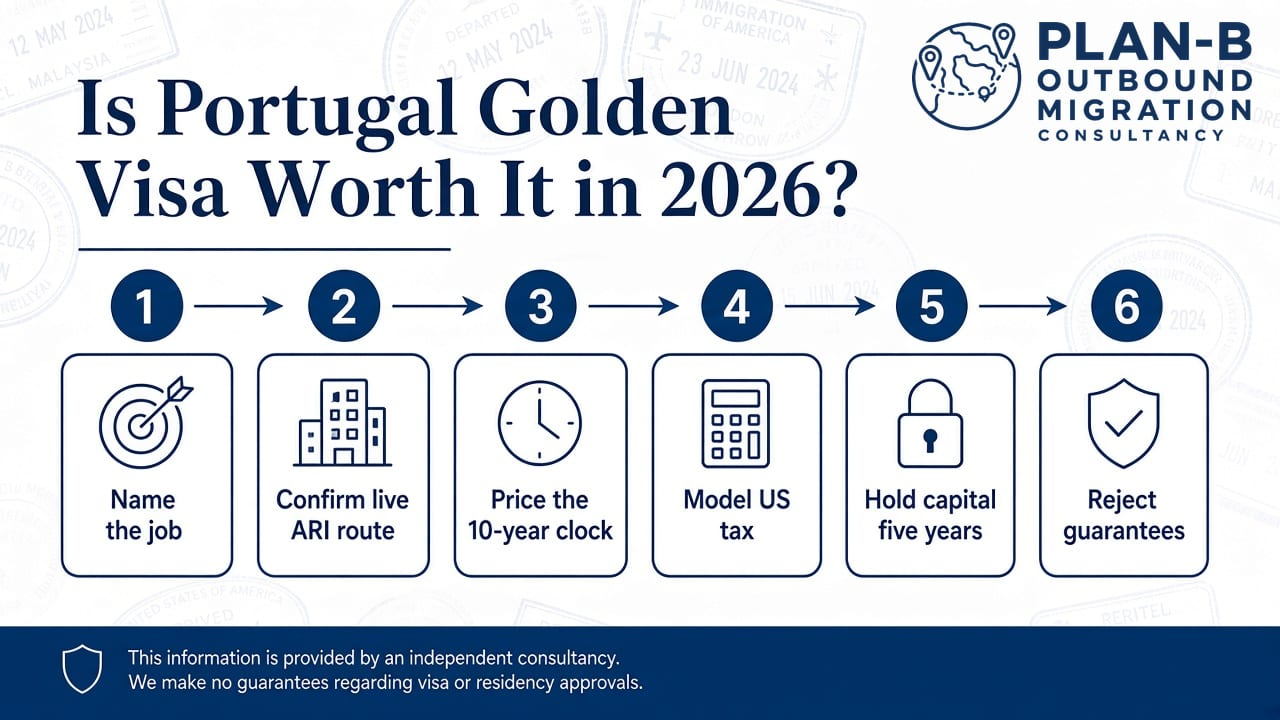
- Name the job: mobility Plan B, relocation, tax story, or passport
- Confirm the live ARI route on AIMA: fund, jobs, research, culture, or company, never a house
- Price the 10-year US naturalization clock and civic tests, not a 2017 five-year slide
- Model Form 1040, FBAR, FATCA, and PFIC with a US CPA before subscription
- Read the fund lock-up, fees, and exit clause, or treat a cultural transfer as spent capital
- Reject guaranteed approval language and any pressure to wire before diligence
This is where a US-based coordinator earns its fee. Plan-B provides A to Z concierge support, including Portuguese tax ID acquisition, bank account opening, documentation processing, and apostille handling. We helped Jason C. get his Portuguese Tax ID quickly with minimal work on his end, and David B. open a Portuguese bank account despite it not being an easy task.
Because we are a verifiable US company led by a licensed attorney, clients can share financial records without wondering who sits behind a foreign-based firm's virtual US address. Our bigger competitors, large brand names and legal firms, typically charge more for the same filing.
If you want to talk through your options, Plan-B offers a complimentary 30-minute consultation with a US-based specialist. Bring immigration, tax, and Portuguese fund questions into the same conversation.
FAQ
Is the Portugal Golden Visa still worth it in 2026 if citizenship is my main goal?
Only marginally. A new US applicant faces 12 to 30 months of AIMA processing, then 10 years of legal residence under Organic Law 1/2026, then nationality processing. Plan for 12 to 14 or more years from wire to passport, and confirm how your clock is counted. Our Portugal Golden Visa citizenship timeline lays out each phase year by year.
Can US citizens still get a Golden Visa for Portugal in 2026?
Yes. US citizens remain among the largest applicant groups, and nothing in the 2023 or 2026 reforms excluded Americans. You need a clean criminal record, a Portuguese NIF and bank account, health insurance, and a qualifying €500,000 fund subscription or other live route. The main US-specific issues are PFIC reporting on the fund and FBAR filing on Portuguese accounts.
What is the latest news on the Portugal Golden Visa?
As of October 2026, the program is open with fund, research, cultural, company, and job-creation routes. Organic Law 1/2026 took effect on 19 May 2026 and set a 10-year naturalization period for US nationals. AIMA renewals moved online on 16 February 2026. Processing backlogs of 18 to 30 months continue, and a collective lawsuit by more than 500 applicants is pressing AIMA on delays.
Which EU country is easiest to get permanent residency in compared with Portugal?
Greece has the lowest entry price and no stay requirement, but its path to citizenship requires real residence and Greek language skills. Portugal still offers the lightest presence rule for a fund-based permit. Italy and Malta have higher capital thresholds, and Spain closed its program in April 2025. The easiest program depends on whether you want property, mobility, or a passport.
Should I apply now or wait for more clarity on the rules?
Apply now if your family needs the residence card as a mobility Plan B and can hold €500,000 in a fund for five years while AIMA processes the file. Wait only if you do not need the card this year, because every reform since 2022 has narrowed the program. Either way, confirm the live AIMA route and model US tax before any wire.
Next step
If you are still weighing whether the Portugal Golden Visa is worth it in 2026, name the job first, confirm the live AIMA route, then price the ten-year clock and your US tax position before any capital moves.
Plan-B Outbound Migration Consultancy offers a complimentary 30-minute consultation from its Beverly Hills and Vancouver offices, led by a California licensed immigration attorney who has worked in investment migration since 2009.
Disclaimer: General information only, not legal or tax advice. Immigration and tax rules change. Confirm all requirements with licensed US and Portuguese professionals and official government sources before applying, investing, or relocating. No outcome is guaranteed.