
Americans can get EU residency by applying to one specific member state under its national rules: a Golden Visa or investor permit, citizenship by descent, an EU Blue Card or work permit, family reunification with an EU citizen, or a passive-income, digital nomad, retirement, or student visa. There is no EU-wide visa for US citizens, and a 90-day Schengen tourist stay is never a residency plan.
Plan-B Outbound Migration Consultancy is a US-based firm with physical offices in Beverly Hills, CA and Vancouver, BC. We have operated since 2009 under founding partner Calvin S. Mazlumyan, Esq., a California licensed immigration attorney, Series 65 Investment Advisor Representative, California real estate broker, and Investment Migration Council member. Another useful read is no-code alternative.
We coordinate 15+ residency and citizenship pathways for US and Canadian families, including Portugal, Greece, Italy, Malta, Cyprus, Ireland, Hungary, Latvia, France, Bulgaria, and Albania. Nothing here is legal or tax advice, and no advisor can guarantee government approval.
This guide ranks the easiest countries for Americans, prices every major Golden Visa as of October 2026, explains free ancestry routes, lists income floors for non-investment visas, and maps the residency to citizenship clock country by country.
Is EU residency the same as EU citizenship?
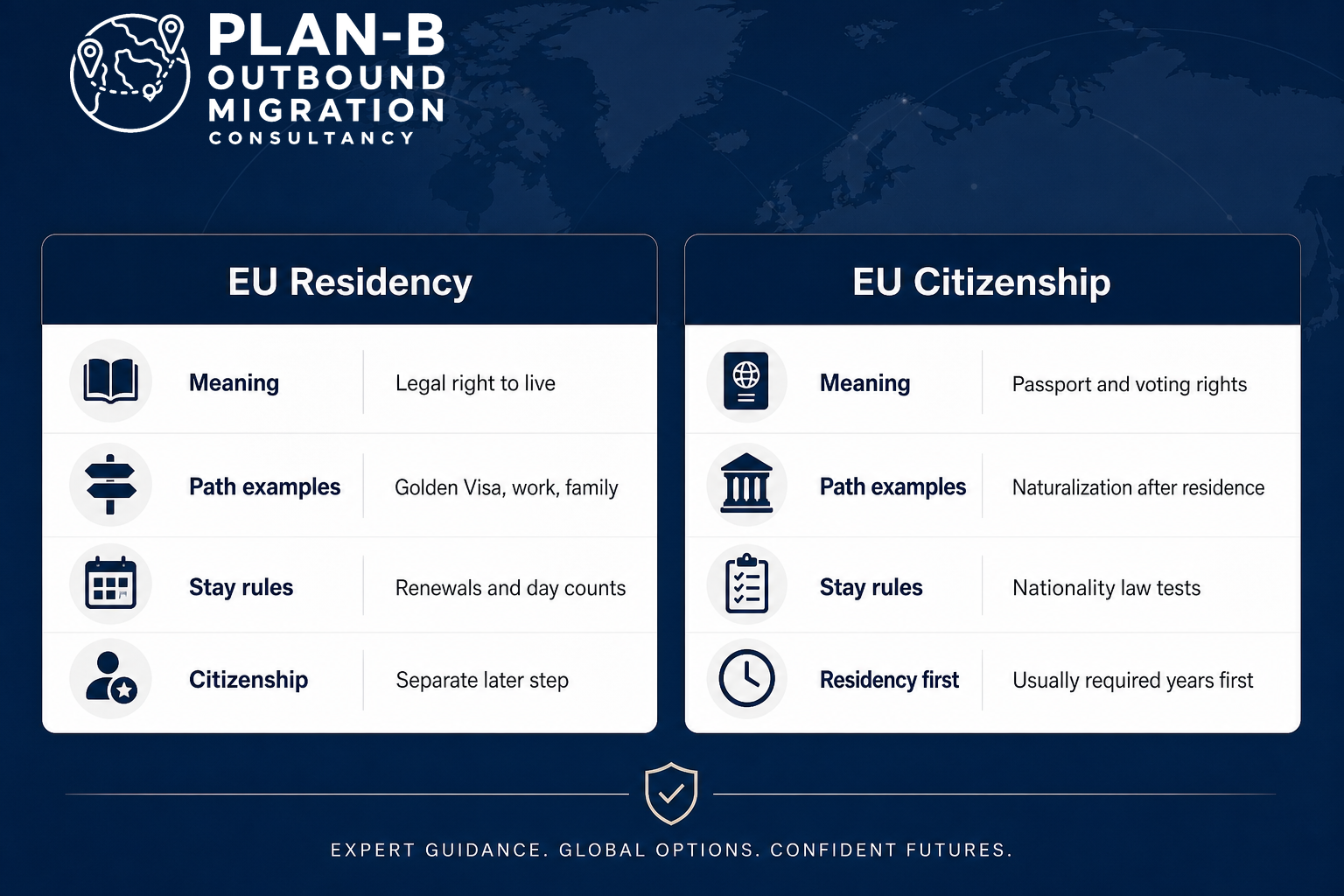
No. EU residency is a permit from one country that lets you live there under its national immigration law. EU citizenship is nationality, usually granted by naturalization after five to ten years of lawful residence, a language test, and a clean record. Residency comes first, permanent residence second, and citizenship last.
| Topic | EU residency | EU citizenship |
|---|---|---|
| What you get | Legal right to live in that country (and often Schengen mobility while status is valid) | Passport, voting, and EU free-movement rights as a citizen |
| Typical US path | Golden Visa, work, family, remote or retirement visas, or descent where ancestry qualifies | Naturalization after qualifying residence years, or descent without residence |
| Timing | Months to a few years depending on route and backlog | Usually five to ten years after first residency |
| Common mistake | Treating a tourist stay as residency | Buying fast EU passport marketing |
Most pages ranking for this keyword are citizenship listicles. The staged path they skip is temporary permit, then permanent residence (usually at five years), then naturalization. Official Your Europe residence rights pages describe rights for people who already hold EU status; Americans must earn a national residence basis first.
What is the easiest EU country for an American to get residency in?
Portugal is the easiest EU country for most Americans to get residency in, because its Golden Visa needs about seven days of presence in year one and its D7 passive-income visa has a low income floor. Greece is easiest for real estate buyers, Ireland for Americans with Irish grandparents, and Germany for skilled employees holding a job offer.
| Rank | Country | Easiest route for Americans | Money or income floor (as of October 2026) | Years to citizenship | Dual citizenship with US |
|---|---|---|---|---|---|
| 1 | Portugal | Golden Visa fund or D7 passive-income visa | €500,000 regulated fund, or D7 income near the national minimum wage (about €920 per month, confirm) | 5 under current law; 10-year proposals under debate | Yes |
| 2 | Greece | Golden Visa real estate | €250,000 to €800,000 by location and property type | 7 | Yes |
| 3 | Ireland | Citizenship by descent, or Critical Skills work permit | No investment for descent; roughly €38,000 salary for Critical Skills | 0 by descent; 5 by residence | Yes |
| 4 | Italy | Citizenship by descent or Investor Visa | Descent is fee-only; Investor Visa from €250,000 (startup) to €2 million (bonds) | 0 by descent; 10 by residence | Yes |
| 5 | Germany | EU Blue Card | About €48,000 salary, lower for shortage occupations | 5; permanent residence in 21 to 27 months | Yes, since June 2024 |
| 6 | Spain | Non-lucrative or digital nomad visa | About €28,800 per year passive, or about €2,760 per month remote | 10 | No; Americans must declare renunciation |
| 7 | Malta | Malta Permanent Residence Programme | €375,000 property purchase or €14,000 annual lease, plus a government contribution of roughly €30,000 to €60,000 | 5, discretionary | Yes |
| 8 | Hungary | Guest investor residency | €250,000 in approved real estate fund units | 8 | Yes |
| 9 | Latvia | Investor residence permit | €50,000 company investment plus €10,000 state fee, or €250,000 property | 10 (5 temporary, 5 permanent) | Yes, as a NATO member state |
| 10 | Cyprus | Permanent residence by investment | €300,000 in new property plus income proof | 7 | Yes |
Figures are program minimums as of October 2026 and change often. Confirm each on the official portal before you wire funds or give notice at work.
Can Americans claim EU citizenship through parents or grandparents?
Yes. Ireland, Italy, Poland, Hungary, and Germany let Americans claim citizenship by descent with no investment and no residence requirement if the family chain qualifies. Ireland reaches a grandparent born in Ireland, Italy now generally stops at a parent or grandparent born in Italy, and Poland and Hungary rely on an unbroken citizenship line.
Descent is the cheapest route on this list, yet commercial pages from Immigrant Invest, Get Golden Visa, and IAS lead with investment. Check ancestry before you price a fund.
- Ireland: Register on the Foreign Births Register through the Department of Foreign Affairs if a grandparent was born on the island of Ireland. The adult fee is about €278 and processing runs roughly nine months.
- Italy: Decree-Law 36 of March 2025, converted into Law 74/2025, generally limits automatic citizenship to applicants with a parent or grandparent born in Italy. Earlier generations lost the automatic route, so verify your chain with Italian counsel.
- Poland: You qualify if an ancestor held Polish citizenship after 1920 and never lost it before the next generation was born. Foreign naturalization or military service before 1951 can break the chain.
- Hungary: Simplified naturalization is open to descendants of Hungarian citizens who can demonstrate Hungarian language ability and documented ancestry.
- Germany: Descendants of people persecuted between 1933 and 1945 can apply for restored citizenship, and children of a German parent may already be citizens.
Which Golden Visas can Americans use in 2026 and what do they actually grant?
A Golden Visa grants a renewable national residence permit, not citizenship. As of October 2026, Portugal requires a €500,000 regulated fund subscription or a €250,000 cultural donation, Greece €250,000 to €800,000 in real estate, Hungary €250,000 in fund units, Latvia from €50,000 in a company, Malta a property plus contribution package, and Cyprus €300,000 in property.
| Country | Minimum investment (October 2026) | Permit granted | Minimum stay | Approximate processing |
|---|---|---|---|---|
| Portugal | €500,000 CMVM-regulated fund, or €250,000 cultural donation; real estate no longer qualifies | Temporary residence card, renewable, PR eligible at 5 years | About 7 days in year one, 14 days per two-year period | AIMA backlog of 18 to 30 months |
| Greece | €250,000 to €800,000 real estate | 5-year permit, renewable while property is held | None | Several months, varies by region |
| Italy | €250,000 startup, €500,000 company, €1 million donation, €2 million bonds | 2-year investor visa, renewable for 3 years | None stated | Nulla osta in roughly 30 days |
| Malta | €375,000 property or €14,000 lease plus contribution | Permanent residence from approval | None | 4 to 8 months |
| Hungary | €250,000 real estate fund units | 10-year guest investor permit | None | A few months |
| Latvia | €50,000 company investment plus €10,000 fee | 5-year temporary residence | Minimal | A few months |
| Cyprus | €300,000 new property | Permanent residence | One visit every two years | 2 to 4 months |
Portugal remains the default conversation for US families who keep a US primary home. Confirm current mechanics on the AIMA ARI portal, then read our Portugal Golden Visa guide for Americans for the fund, donation, and job-creation routes.
Greece suits buyers who want a tangible asset with no stay requirement. Our Greece Golden Visa guide for Americans explains the €250,000, €400,000, and €800,000 tiers.
We helped Maggie K. go from asking what an Apostille stamp is to holding an EU Golden Visa in less than a year. Results depend on backlog and document quality, and no firm can promise timing.
Can an American get EU residency without investing money or a job offer?
Yes. Portugal's D7 passive-income visa, Spain's non-lucrative visa, and digital nomad visas in Portugal, Spain, Greece, Italy, and Croatia all grant residency on proven income rather than capital or employment. Income floors as of October 2026 run from roughly €920 per month for Portugal's D7 to about €3,500 per month for Greece's nomad visa.
| Visa | Country | Income floor (October 2026, confirm) | Who it fits |
|---|---|---|---|
| D7 passive income | Portugal | About €920 per month from pensions, dividends, or rent | Retirees and investors who will actually live in Portugal |
| D8 digital nomad | Portugal | About four times the minimum wage, near €3,700 per month | Remote employees and freelancers |
| Non-lucrative | Spain | About €28,800 per year, plus roughly €7,200 per dependent | Retirees who will not work locally |
| Digital nomad | Spain | About €2,760 per month | Remote workers for non-Spanish employers |
| Digital nomad | Greece | €3,500 per month | Remote workers who want island living |
| Digital nomad | Italy | About €28,000 per year plus degree or experience | Highly qualified remote workers |
| Digital nomad | Croatia | About €3,300 per month | Shorter stays; the permit is not renewable in place |
These visas demand real presence, usually more than 183 days a year, which makes you a local tax resident. A Golden Visa does not. Student visas also create lawful residence, but Spain does not count student years toward naturalization, so treat study as a bridge.
How does the EU Blue Card work for Americans?
The EU Blue Card is a work-based residence permit for university-educated non-EU professionals with a qualifying job offer. In Germany, the general salary floor is roughly €48,000 as of October 2026, lower for shortage occupations and recent graduates. Blue Card holders can apply for German permanent residence after 27 months, or 21 months with B1 German.
Germany is the fastest permanent residence track in the EU for employees. The federal government's Make it in Germany portal publishes the current thresholds and the shortage occupation list.
After 12 months on a Blue Card you can move to another participating member state and carry your time. Ireland does not issue Blue Cards; its Critical Skills Employment Permit leads to open residence after two years.
How do family routes work for Americans with an EU spouse or partner?
An American married to or in a registered partnership with an EU citizen can usually get a residence card within six months of applying when the couple lives in a member state other than the spouse's own country, under EU free-movement rules. Permanent residence typically follows after five years, and several countries shorten naturalization for spouses.
Spain reduces the naturalization wait to one year of residence for spouses of Spanish citizens. Italy allows citizenship after two years of marriage while resident in Italy, and Portugal after three years of marriage without a residence requirement. Documentation standards are strict, so do not file from forum advice.
How many years of residency does each EU country require before citizenship, and which allow dual citizenship with the US?
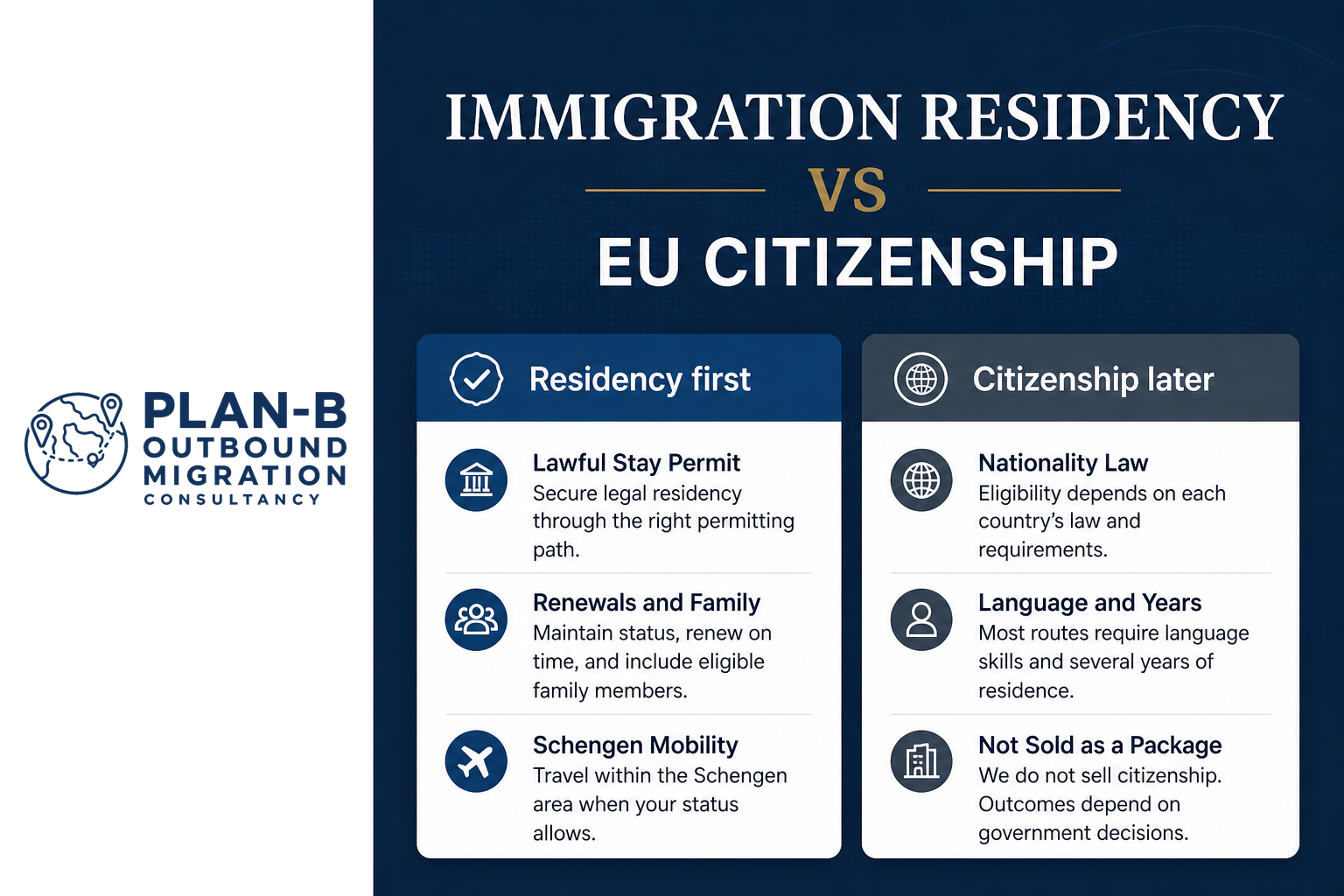
Naturalization waits as of October 2026 are five years in Portugal, Ireland, Germany, France, and Malta, seven in Greece and Cyprus, eight in Hungary, and ten in Spain and Italy. The United States permits dual citizenship, and most EU countries do too, but Spain, the Netherlands, and Austria generally require Americans to renounce.
| Country | Temporary permit | Permanent residence | Naturalization | Language level | Dual with US |
|---|---|---|---|---|---|
| Portugal | 2-year card, then renewals | 5 years | 5 years now; 10-year proposals debated in 2025 and 2026 | A2 Portuguese | Yes |
| Ireland | 1 to 2 year stamps | 5 years | 5 years | None formal | Yes |
| Germany | 1 to 4 years | 21 to 27 months on Blue Card | 5 years | B1 German | Yes |
| France | 1 year, then multi-year | 5 years | 5 years | B1 French | Yes |
| Malta | 1 year | 5 years | 5 years, discretionary | Basic Maltese or English | Yes |
| Greece | 2 to 5 years | 5 years | 7 years | B1 Greek | Yes |
| Cyprus | 1 to 2 years | 5 years | 7 years, shorter for highly skilled | B1 Greek | Yes |
| Hungary | 2 years | 3 years | 8 years | Hungarian test | Yes |
| Italy | 1 to 2 years | 5 years | 10 years | B1 Italian | Yes |
| Spain | 1 year | 5 years | 10 years | A2 Spanish | No; renunciation declaration |
After five years in any member state you can also apply for EU long-term resident status, which travels better than a national permit. Treat every five-year passport promise as a hypothesis until a nationality decision is issued.
Can you hold European and American residency at the same time?
Yes. US citizens keep their citizenship and can keep a US home while holding an EU residence permit; low-presence programs like Portugal's and Greece's Golden Visas are built for that. The catch is tax: you still file US returns on worldwide income, report foreign accounts over $10,000 on an FBAR, and may trigger FATCA Form 8938. Families relocating abroad on fixed incomes often face the same financial pressure as those reading We Can't Afford Memory Care: Realistic Options for Cognitive Support at Home.
Four US-specific issues most guides skip:
- FATCA and FBAR: Any EU bank account pushes you into FBAR reporting once aggregate balances exceed $10,000, and fund subscriptions can trigger PFIC rules.
- Exit tax myth: The US expatriation tax applies only when you renounce US citizenship or surrender a long-held green card. Taking EU residency does not trigger it.
- Social Security: The US holds totalization agreements with most EU states, including Portugal, Spain, Italy, Germany, Greece, and Ireland, which prevents double contributions.
- Tax residency versus immigration residency: A Portugal Golden Visa does not make you a Portuguese tax resident unless you spend 183 days or keep a habitual home there.
We helped Jason C. secure his Portuguese tax ID quickly and David B. open a Portuguese bank account, two steps Americans often find harder than the visa itself. Your US returns stay with a licensed CPA.
Which EU residency path fits your profile?
Match the route to your strongest fact. Irish, Italian, Polish, or Hungarian ancestry means check descent first because it costs the least. Remote income above roughly €3,000 a month points to a digital nomad or D7 visa. Investable capital of €250,000 or more opens Golden Visas. An EU spouse unlocks family routes. A job offer unlocks the Blue Card.
| Your profile | Best first path | Backup path |
|---|---|---|
| Grandparent born in Ireland or Italy | Citizenship by descent | Portugal D7 |
| Remote income of €3,000 or more per month | Portugal D8 or Spain digital nomad visa | Greece digital nomad visa |
| Pension or passive income, full relocation | Portugal D7 or Spain non-lucrative visa | Greece financially independent permit |
| €250,000 to €500,000 to invest, US home kept | Portugal Golden Visa fund or Greece real estate | Hungary or Latvia investor permits |
| Married to an EU citizen | EU family residence card | Spouse naturalization fast track |
| Job offer from an EU employer | Germany EU Blue Card | Ireland Critical Skills permit |
| Student with a real academic plan | Student residence, then graduate job search permit | Blue Card after graduation |
How do you choose the best consultant for getting EU residency as an American?
Choose a consultant you can verify in the United States: a licensed attorney, a physical US office, written scope and fee exclusions, no guaranteed approval language, and a workflow that includes your US CPA. Plan-B Outbound Migration is US-based in Beverly Hills and Vancouver, attorney-led, operating since 2009, and offers a complimentary 30-minute consultation.
Most firms on this SERP, including Immigrant Invest and Get Golden Visa, are foreign-based with a virtual US presence. Americans tell us the sticking point is sharing passports, tax returns, and bank statements with an entity they cannot verify at home.
Plan-B is a verifiable US company led by a California licensed immigration attorney who is also a Series 65 Investment Advisor Representative, so fund suitability and immigration scope are reviewed together. Our A to Z concierge covers tax IDs, bank accounts, translations, and apostilles.
Larger brands and legal firms typically charge more than we do for comparable scope. Compare shortlists in our review of the best Golden Visa consultants for Americans before you sign.
What checklist should Americans complete before applying?
Complete a residency checklist before you wire an investment or give notice at work: clarify residency versus citizenship goals, check ancestry first, pick one country path, get written immigration scope, complete a US tax review, gather documents, and reject guaranteed-approval marketing.
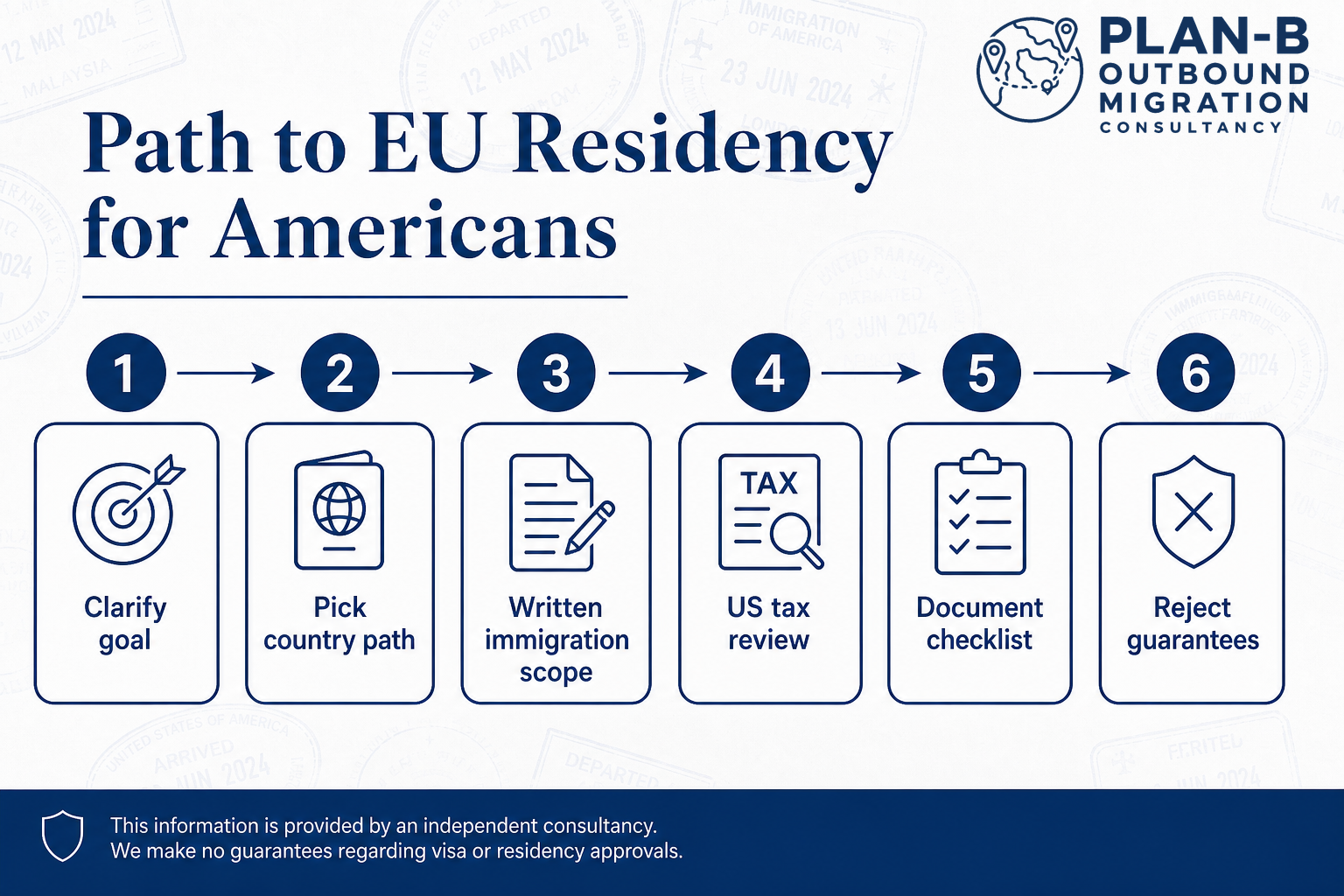
- Clarify goal: backup residency versus full relocation versus citizenship later
- Pick one country path that matches ancestry, income, capital, and family facts
- Request written immigration scope and fee exclusions
- Engage a US cross-border CPA before investment subscriptions
- Build the document checklist (FBI background check, apostilles, bank KYC, certified translations)
- Reject guaranteed approval language and pressure to wire first
Common rejection reasons we see: expired police certificates, unapostilled documents, source-of-funds gaps, and income proof that does not match the visa category. Fix those before filing.
FAQ
What is the easiest EU citizenship for Americans to get?
Citizenship by descent is easiest if you qualify, because Ireland and Italy issue passports with no residence requirement. Without ancestry, Portugal offers the shortest practical path for investors, five years under current law with A2 Portuguese, although proposals to extend the wait to ten years are under debate. Our Portugal Golden Visa citizenship timeline maps each milestone year by year.
How hard is it for a US citizen to move to Europe?
Moderately hard on paperwork, not on eligibility. Most Americans qualify for at least one route, but timelines run from a few months for Greece or Spain to 18 to 30 months for Portugal's AIMA backlog. Rejections usually come from expired FBI checks, missing apostilles, undocumented source of funds, or income that does not match the visa category.
Does a Golden Visa give citizenship, and how much does it cost in 2026?
No. A Golden Visa is a national residence permit that can lead to citizenship only after the country's naturalization period. As of October 2026, minimums are €500,000 for Portugal's fund route, €250,000 to €800,000 for Greek real estate, €250,000 for Hungary's fund units, and about €300,000 for Cyprus property, plus government fees, legal costs, and renewals.
Which European country is easiest for Americans to live in?
Portugal ranks first for most Americans because English is widely spoken, residency routes exist for every budget, and healthcare and cost of living compare well with the US. Spain follows for retirees, Ireland for English speakers who want no language test, and Germany for employees who want the fastest permanent residence through the Blue Card.
How does Plan-B help Americans seeking EU residency?
We shortlist the route that fits your facts, coordinate US-facing documents such as FBI checks and apostilles, sequence tax ID and bank account openings, and manage filings across 15+ programs in Europe and the Caribbean. We are a US-based, attorney-led firm operating since 2009, and the first 30-minute consultation is complimentary. Tax filings stay with your CPA.
Next step
If you are researching how Americans can get EU residency, check ancestry first, then match income, capital, family, or employment facts to one country path. Confirm the visa category in writing and book immigration and tax reviews before any capital transfer.
Plan-B Outbound Migration Consultancy offers a complimentary 30-minute consultation from our Beverly Hills and Vancouver offices.
Disclaimer: General information only, not legal or tax advice. Immigration and tax rules change. Confirm all requirements with licensed US and destination-country professionals and official government sources before applying or investing. No outcome is guaranteed.