
The best European countries for Americans to move to in 2026 are Portugal, Greece, Spain, Italy, Ireland, the Netherlands, Germany, France, Malta, and Cyprus, ranked by whether a US family can lawfully stay without an EU job offer, what it costs to qualify, how workable English is, and how US tax rules interact with each country.

If you searched best european countries for americans to move to 2026, you want more than a lifestyle ranking. Americans need a legal path to stay, a realistic cost model, and a clear split between immigration residency and tax residency. US citizenship-based taxation does not disappear when you buy a one-way ticket. Another useful read is build apps with ai.
Plan-B Outbound Migration Consultancy is a Beverly Hills practice (operating since 2009, with a second office in Vancouver, BC) led by founding partner Calvin S. Mazlumyan, Esq., a California licensed immigration attorney, Series 65 Investment Advisor Representative, and Investment Migration Council member. We help US and Canadian families shortlist Europe, then coordinate documents, tax ID numbers, bank accounts, and apostilles before capital moves.
Nothing here is legal or tax advice. No advisor can guarantee government approval outcomes. Every threshold below is dated as of October 2026 and should be confirmed on the official portal linked for each country before you file. Americans relocating to Europe who want to practice low-risk investing abroad often start with the Crypto Trading Simulator for Beginners: 7 Apps Ranked for 2026 before committing real capital overseas.
Why are Americans leaving the US for Europe in 2026?
Americans move to Europe in 2026 for four recurring reasons: lower out-of-pocket healthcare costs, a desire for political and personal stability, better work-life balance, and the optionality of a second residency or passport. Most of our clients are not fleeing anything. They want a lawful Plan B that works before they need it.
The pattern we see from US families in consultations:
- Healthcare: public or hybrid systems in Portugal, Spain, Italy, and France cost a fraction of US private premiums once you hold residency
- Stability: a second residency hedges against domestic uncertainty without requiring you to give up US citizenship
- Lifestyle: walkable cities, safer streets, and 20 to 30 paid vacation days are standard across the EU
- Mobility: EU residency unlocks Schengen travel without the 90-in-180 day tourist limit
The mistake is treating Europe as one place. The visa that works for a retiree in the Algarve does not work for a remote software engineer in Berlin.
Which European countries rank best for Americans in 2026?
Portugal ranks first for Americans in 2026 because it still offers an investment residency route with minimal physical presence, a passive income visa, and a digital nomad visa. Greece, Spain, Italy, and Ireland follow for lifestyle and income-based routes. The Netherlands, Germany, France, Malta, and Cyprus round out the top ten for specific profiles.
The table below is the side-by-side most ranking pages skip. Figures are approximate, as of October 2026, and must be confirmed with the issuing authority before you rely on them.
| Rank | Country | Main route for Americans without an EU job | Minimum income or investment (approx., Oct 2026) | Typical processing | Citizenship clock |
|---|---|---|---|---|---|
| 1 | Portugal | Golden Visa (fund), D7 passive income, D8 digital nomad | €500,000 fund; D7 about €870/month; D8 about €3,500/month | Golden Visa 18 to 30 months via AIMA; D7 about 2 to 3 months | 5 years in force; 10 years under debate |
| 2 | Greece | Golden Visa (real estate), Financially Independent Person visa | €250,000 to €800,000 by zone; FIP about €3,500/month | Golden Visa about 3 to 6 months | 7 years |
| 3 | Spain | Non-lucrative visa, digital nomad visa | NLV about €2,400/month; DNV about €2,760/month | 1 to 3 months | 10 years |
| 4 | Italy | Elective residence, investor visa, digital nomad visa | ER about €31,000/year; investor €250,000 to €2 million | 1 to 4 months | 10 years (faster by descent if eligible) |
| 5 | Ireland | Stamp 0 retiree, work permit, citizenship by descent | Stamp 0 about €50,000/year per person; permits from about €34,000 salary | Several months; Foreign Births Register 9+ months | 5 years |
| 6 | Netherlands | Dutch-American Friendship Treaty (DAFT) business permit | About €4,500 business capital | About 2 to 3 months | 5 years, dual citizenship restricted |
| 7 | Germany | EU Blue Card, Opportunity Card, freelance visa | Blue Card salary about €48,000 (confirm 2026 figure) | 1 to 3 months | 5 years, dual citizenship allowed |
| 8 | France | Long-stay visitor visa, Talent Passport | Visitor about €1,800/month passive income | Weeks to 2 months | 5 years |
| 9 | Malta | Permanent Residence Programme, Nomad Residence Permit | Property rent from about €14,000/year plus contributions; Nomad about €3,500/month | 4 to 8 months | Long naturalisation, no reliable investor route |
| 10 | Cyprus | Permanent residency by property, digital nomad visa | €300,000 property; DNV about €3,500/month | 2 to 4 months | 7 to 8 years; not yet full Schengen |
What does each of the top 10 countries look like for an American family?
Each country below is profiled on the same five points: the visa route an American can realistically use, what it costs to qualify, cost of living, healthcare access, and English practicality. Rankings weigh legal clarity for non-EU nationals first, then lifestyle, because lifestyle without a permit ends at 90 days.
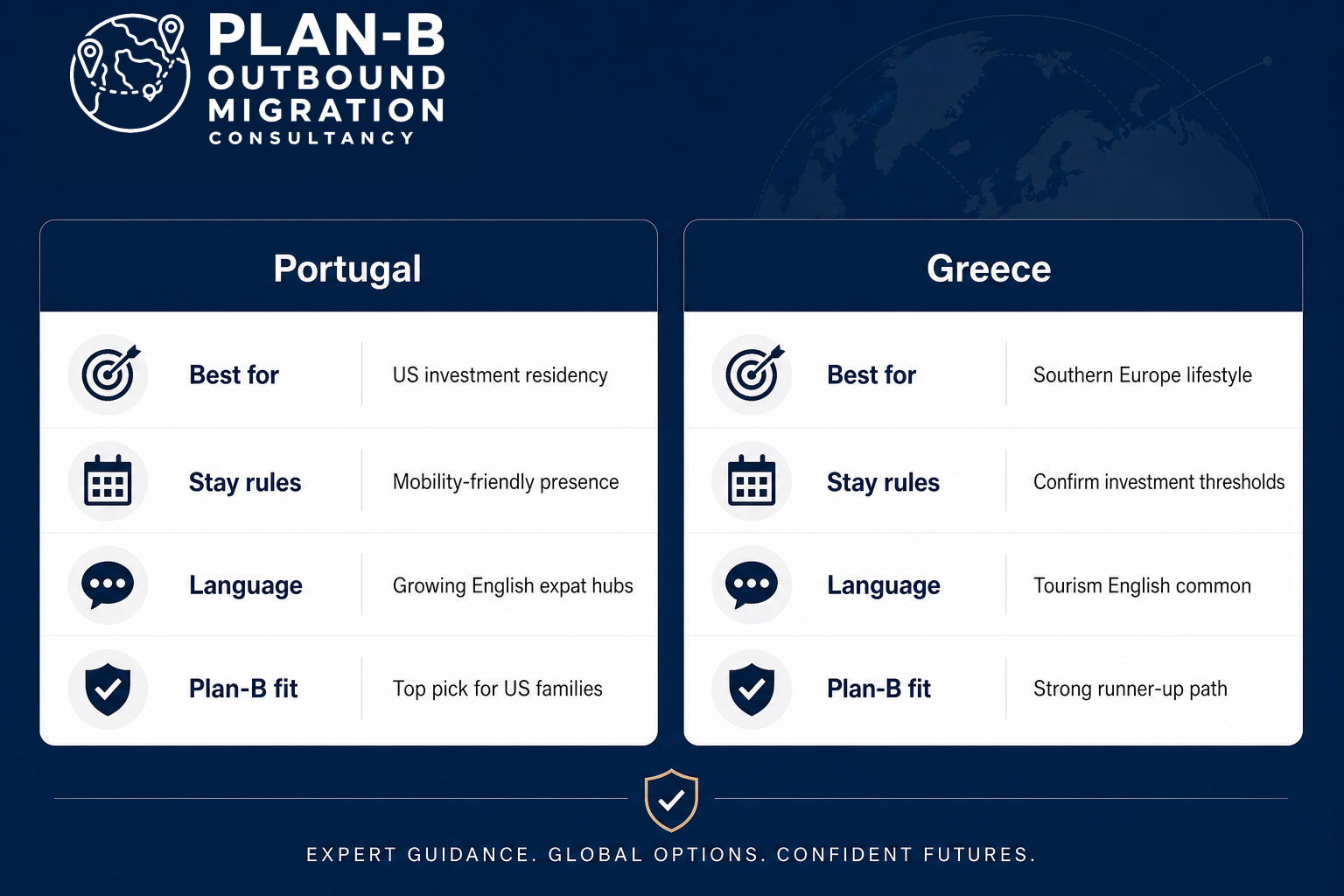
1. Portugal (top pick for Plan-B style US families)
Portugal keeps the top spot because it offers three distinct lanes. The Golden Visa, now a €500,000 CMVM-regulated fund route since real estate exited in October 2023, requires roughly seven days of presence in year one and fourteen days per two-year period. The D7 passive income visa and D8 digital nomad visa suit retirees and remote workers who will actually live there.
Cost of living outside Lisbon runs well below US coastal cities, and the public SNS health system is available to residents. English is widely spoken in Lisbon, Porto, and the Algarve. The honest downside is AIMA processing, which has stretched to 18 to 30 months for Golden Visa files, and a live parliamentary debate on extending the citizenship wait.
Confirm current rules on the AIMA ARI portal, then read our Portugal Golden Visa guide for Americans for the US filing sequence.
2. Greece
Greece is the closest runner-up for families who want a Golden Visa that still accepts real estate. Thresholds are zoned: €800,000 in Athens, Thessaloniki, Mykonos, Santorini, and larger islands, €400,000 elsewhere, and €250,000 for qualifying conversions or restorations. There is no minimum stay to keep the permit.
The Financially Independent Person visa, at about €3,500 per month, covers retirees and remote earners. Living costs are among the lowest in Western Europe, healthcare is public with strong private options, and English is common in tourism zones but thin in administration. Confirm categories on migration.gov.gr and see our Greece Golden Visa guide for Americans.
3. Spain
Spain closed its Golden Visa on April 3, 2025, so Americans now use the non-lucrative visa (about €2,400 per month in passive income, no local work allowed) or the digital nomad visa (about €2,760 per month from non-Spanish employers). The Beckham law can tax qualifying newcomers at a 24 percent flat rate on Spanish-source income for six years.
Healthcare is excellent and public once you are resident. English is strong in Madrid, Barcelona, Valencia, and Malaga, weaker inland. Watch housing: anti-tourism protests and rent pressure in Barcelona and the Balearics are real, and spending 183 days triggers Spanish tax residency on worldwide income.
4. Italy
Italy offers the elective residence visa (about €31,000 per year in passive income for an individual, more for couples), a four-route investor visa from €250,000, and a digital nomad visa at about €28,000 per year. The €200,000 annual flat tax on foreign income attracts high earners, and a 7 percent flat tax exists for foreign retirees settling in small southern towns.
Living costs vary wildly between Milan and Puglia. Healthcare is public and good. English is workable in big cities, not in municipal offices. Citizenship by descent was narrowed in March 2025 to parents and grandparents, so verify eligibility before counting on it. Our guide to the best Italy Golden Visa routes compares the four investment options.
5. Ireland
Ireland is the easiest country for English-first households, with no language barrier at all. Routes are narrower: the Stamp 0 retiree permission needs about €50,000 per year per person plus a lump sum, employment permits start near €34,000 in salary, and the Foreign Births Register grants citizenship to anyone with an Irish-born grandparent.
The investor programme closed in 2023, so Ireland is not a Portugal substitute. Dublin rents rival San Francisco and the housing shortage is severe. Healthcare is a public-private hybrid. Start diligence with Ireland's Department of Foreign Affairs.
6. Netherlands
The Netherlands has a route almost no other country offers Americans: the Dutch-American Friendship Treaty. With about €4,500 in business capital and a registered Dutch enterprise, a US citizen can secure a two-year self-employment permit. English proficiency is the highest in continental Europe.
Downsides: Amsterdam housing is scarce and expensive, mandatory private health insurance runs roughly €150 per month per adult, the 30 percent expat ruling is being trimmed, and naturalisation generally requires giving up US citizenship.
7. Germany
Germany fits Americans with a job offer or in-demand skills. The EU Blue Card (salary threshold about €48,000, lower for shortage occupations), the points-based Opportunity Card for job seekers, and the freelance visa are the main doors. Dual citizenship has been allowed since June 2024, with naturalisation after five years.
Cost of living is moderate outside Munich. Public insurance costs about 15 percent of gross salary split with the employer. English works in Berlin tech, but immigration offices and landlords expect German.
8. France
France's long-stay visitor visa requires roughly French minimum wage in passive income, about €1,800 per month, and prohibits work. The Talent Passport covers skilled employees, founders, and investors. Residents can join the public health system after three months.
Paris is expensive; Lyon, Bordeaux, and the southwest are not. English is the weakest among the top eight, and bureaucracy rewards patience and translated documents.
9. Malta
Malta is an English-speaking EU member with a Permanent Residence Programme built on property rental or purchase plus government contributions, and a Nomad Residence Permit at about €3,500 per month with a 10 percent tax rate. The island is small, hot, and increasingly crowded, and the citizenship-by-investment scheme was struck down by the EU court in 2025.
10. Cyprus
Cyprus grants permanent residency through a €300,000 property purchase and offers a digital nomad visa at about €3,500 per month. English is widely spoken, non-dom tax status is attractive for investors, and living costs are modest. It is not yet a full Schengen member, so the permit does not unlock visa-free travel to the rest of the EU.
Switzerland and the UK appear on many lists but rank below the ten above for Americans without an employer: Switzerland limits non-EU permits to sponsored hires and wealthy lump-sum taxpayers, and the UK's Skilled Worker route requires a licensed sponsor and a salary above about £41,700, with no investor visa since 2022.
What is the easiest European country for Americans to move to?
For Americans with passive or remote income, Portugal is the easiest European country to move to in 2026 because the D7 and D8 visas have low thresholds and clear consular steps. For retirees, Greece's Financially Independent Person visa is the simplest. For English-only households, Ireland and Malta remove the language barrier entirely.
"Easiest" depends on your income source:
- Passive income or pension: Portugal D7, Greece FIP, Spain non-lucrative
- Remote salary from a US employer: Portugal D8, Spain digital nomad, Italy digital nomad
- Self-employed entrepreneur: Netherlands DAFT
- Capital to invest without relocating: Portugal fund, Greece real estate, Italy investor visa
- Irish or Italian ancestry: citizenship by descent beats every visa
Which European countries can Americans move to without speaking another language?
Ireland and Malta use English as an official language, so every form, lease, and doctor's visit works in English. The Netherlands ranks next, with near-universal English fluency in daily life. Portugal, Germany, and Spain are workable in major cities for the first year, but permits, taxes, and schools eventually require the local language or a translator.
Practical English ranking for US movers, as of October 2026: Ireland, Malta, Netherlands, Portugal (Lisbon, Porto, Algarve), Germany (Berlin), Spain (coastal cities), Cyprus, Greece (islands), Italy, France.
Two cautions. Expat communities make English easy socially but slow integration. And citizenship tests in Portugal, Spain, Italy, Germany, and France all require a language exam, typically at A2 or B1 level.
Which country fits your profile: retiree, remote worker, family, or job seeker?
Retirees should look first at Portugal, Greece, Spain, and Italy, where passive income visas and public healthcare align. Remote workers fit Portugal, Spain, and the Netherlands. Families with school-age children favor Portugal, Spain, and Ireland for international schools. Job seekers with in-demand skills fit Germany, the Netherlands, and Ireland.
| Profile | Strongest fits | Why |
|---|---|---|
| Retiree on pension or investments | Portugal, Greece, Spain, Italy | Passive income visas from about €870 to €3,500/month; 7 percent flat tax options in Greece and southern Italy |
| Remote worker with US employer | Portugal, Spain, Italy, Malta | Digital nomad visas accept foreign payroll; watch 183-day tax residency |
| Family with children | Portugal, Spain, Ireland, Netherlands | International schools, safe cities, one permit can cover dependents |
| Skilled job seeker | Germany, Netherlands, Ireland | Blue Card, highly skilled migrant, and employment permit routes with employer sponsorship |
| Investor wanting a backup residency only | Portugal, Greece, Italy, Cyprus | Minimal or zero stay requirements while holding the investment |
Can you keep a US remote job and live in Europe legally?
Yes, through a digital nomad visa in Portugal, Spain, Italy, Greece, Malta, or Cyprus, each requiring proof of foreign-source income between roughly €2,760 and €3,500 per month as of October 2026. A tourist entry does not authorize remote work, and spending more than 183 days in most countries makes you a local tax resident.
Three issues to settle with your employer before you apply:
- Whether your company will confirm employment in writing for the consulate
- How payroll handles your foreign address and possible permanent establishment questions
- Whether you will exceed 183 days, which changes where your salary is taxed
Do Americans still pay US taxes after moving to Europe?
Yes. US citizens file a federal return on worldwide income no matter where they live. The Foreign Earned Income Exclusion shelters roughly $130,000 of earned income per person for the 2025 tax year, the Foreign Tax Credit offsets European income tax, and FBAR and FATCA reporting apply once foreign accounts exceed $10,000 in aggregate.
The tools, in plain terms:
- FEIE: excludes earned income only, not pensions, dividends, or capital gains, if you meet the physical presence or bona fide residence test described by the IRS Foreign Earned Income Exclusion rules
- Foreign Tax Credit: usually better than FEIE in high-tax countries like Germany, France, and Spain
- FBAR: FinCEN Form 114 when foreign accounts total more than $10,000 at any point in the year
- Form 8938: higher thresholds, filed with your return
- PFIC rules: European mutual funds and some Golden Visa funds carry punitive US treatment, so fund selection needs a US CPA
Country incentives for new residents, as of October 2026: Portugal's IFICI regime (the NHR successor, 20 percent on qualifying professional income for ten years), Italy's €200,000 annual flat tax on foreign income and 7 percent retiree rate, Spain's Beckham law, Greece's 7 percent pensioner rate, and Malta's 10 percent nomad rate. None of them cancels your US return.
Plan-B coordinates immigration scope and sequences documents. Tax returns and fund elections stay with a licensed CPA or tax attorney, and we bring both into the same timeline.
Are Americans still welcome in Europe in 2026, and what changed?
Americans remain welcome as residents and investors in 2026, but several doors narrowed. Spain closed its Golden Visa in April 2025, Portugal is debating a longer citizenship wait, Italy restricted citizenship by descent, and the EU's new Entry/Exit System and ETIAS authorization now track every US visit. Housing backlash targets short-term rentals, not legal residents.
The candid downsides commercial pages gloss over:
- Bureaucracy: Portuguese and Italian appointments can take months; translated, apostilled US documents expire while you wait
- Housing: Lisbon, Barcelona, Dublin, and Amsterdam have shortages that locals blame partly on foreign demand
- Salaries: local jobs pay far less than US equivalents, which is why most Americans keep US income
- Border tracking: biometric entry records make overstaying the 90-in-180 rule a documented offense
Americans visiting before they hold a permit must register under the EU's ETIAS travel authorization once it is fully live. A residence permit replaces that requirement.
What is the path from residency to citizenship in each country?
Most EU countries convert temporary residency to permanent residency at five years and citizenship between five and ten years, with language and integration tests. Portugal, Ireland, Germany, France, and the Netherlands sit at five years as of October 2026; Greece and Cyprus at seven; Spain and Italy at ten. Portugal's five-year rule is under active legislative challenge.
Three points matter more than the headline number. First, Golden Visa holders in Portugal count years of permit validity, not days on the ground, which is why delays at AIMA matter. Second, the Netherlands expects you to renounce US citizenship. Third, Ireland and Italy by descent skip the clock entirely if you qualify.
How do lifestyle lists differ from residency strategy?
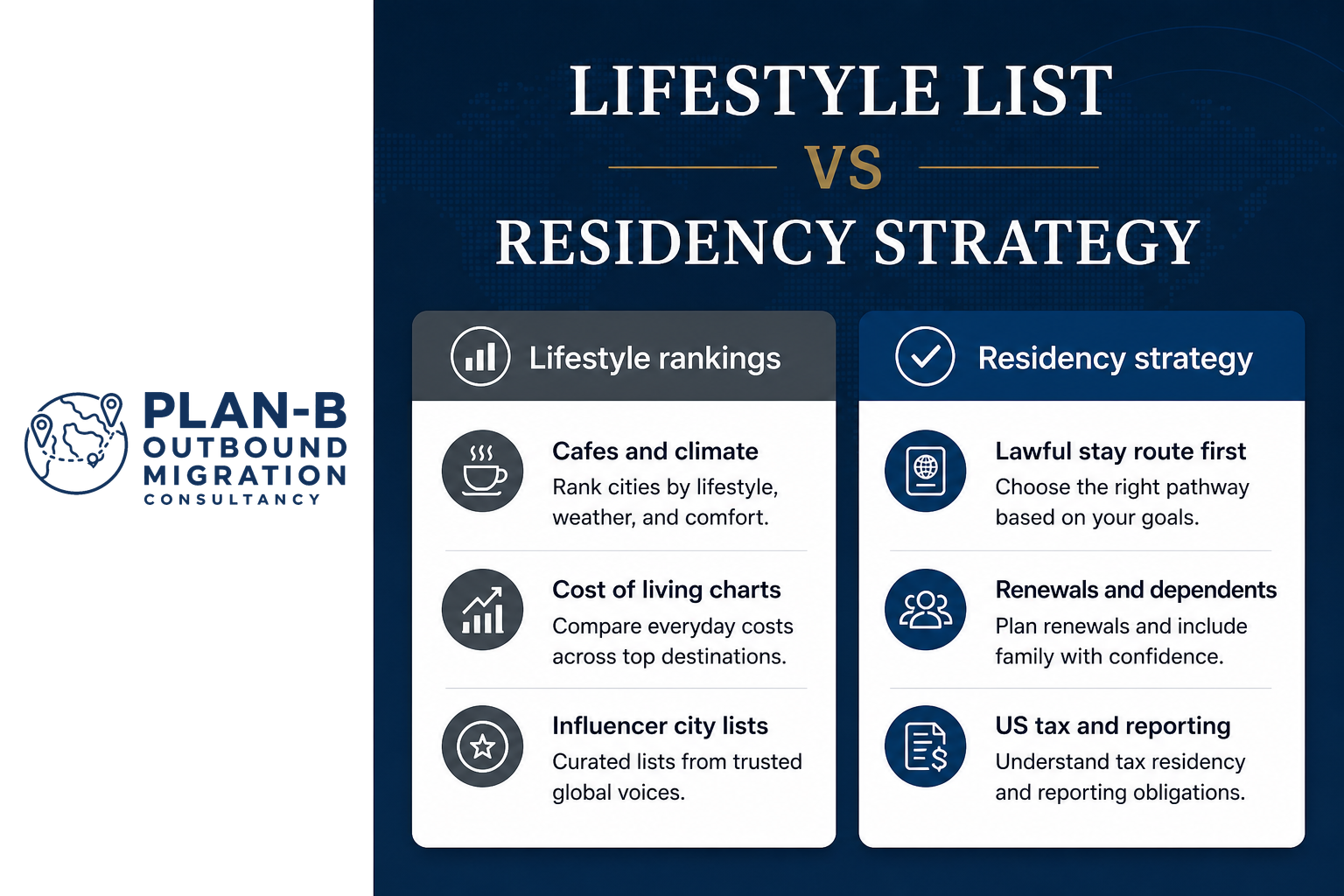
Lifestyle lists rank climate, cafes, and cost of living. Residency strategy ranks legal stay options, renewals, family dependents, and US compliance. Americans who only follow lifestyle lists often discover too late that they cannot lawfully remain after 90 Schengen days.
Fair competitors on this keyword include tax firms such as Greenback, golden-visa marketers such as Get Golden Visa, relocation vendors, and Reddit threads. Use them for cost-of-living, shipping, and candid local context. Use attorney-led counsel for immigration scope.
Plan-B's edge is US-facing legal framing from Beverly Hills: a verifiable US company, a California licensed immigration attorney, and a concierge team that has handled Portuguese tax IDs, bank account openings, and apostille work for clients like Jason C., David B., and Maggie K., who went from asking what an apostille stamp is to holding an EU Golden Visa in under a year.
What checklist should Americans complete before choosing a country?
Complete a residency and reporting checklist before you sell a house, enroll kids abroad, or wire an investment: clarify the goal, shortlist two countries, confirm the visa category in writing, map US tax reporting, check day-count rules, and reject guaranteed-approval marketing. Done in that order, the checklist prevents the most expensive mistakes we see.
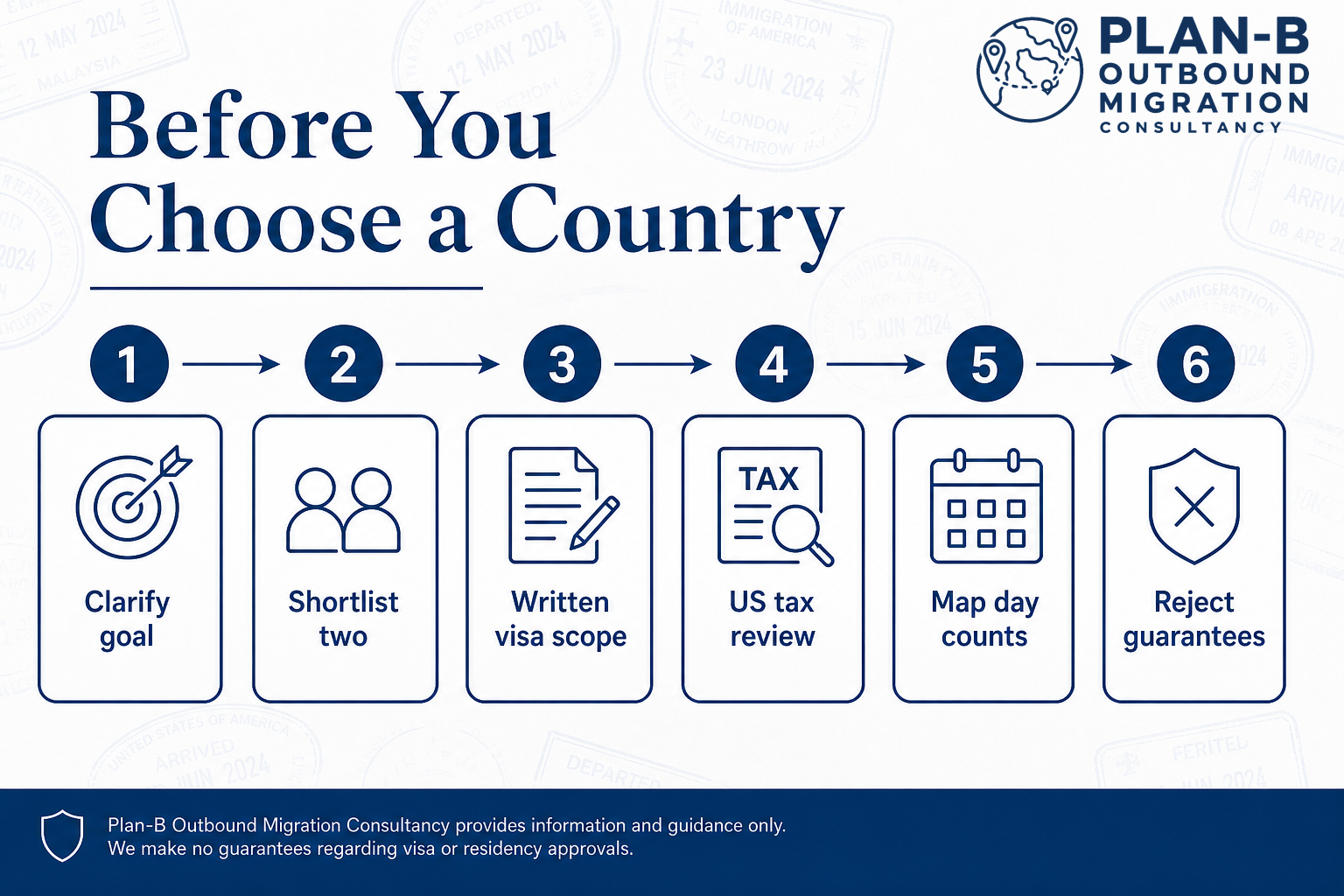
- Separate goals: backup EU residency versus full relocation versus tax residency
- Shortlist two countries with matching visa categories (not vibes alone)
- Request written immigration scope and fee exclusions
- Engage a US cross-border CPA before any investment subscription
- Map day-count rules against Schengen limits and local tax residency tests
- Reject guaranteed approval language and pressure to wire first (USCIS scam diligence mindset)
Plan-B offers a complimentary 30-minute consultation. Bring tax counsel into the same timeline as immigration scoping.
FAQ
What is the best European country for Americans to move to in 2026?
Portugal is the strongest default for US families who want an investment-led or passive-income residency with minimal stay rules and a mature English-speaking expat base. Greece is the closest alternative for real estate investors. Spain, Italy, and Ireland win on lifestyle or English ease when your income type matches the visa category. Our Portugal Golden Visa citizenship timeline explains how long the Portuguese path really takes.
Which European countries are Americans actually moving to in 2026?
Portugal, Spain, Italy, Ireland, and the Netherlands draw the largest flows of US residents, based on the visa categories Americans use most. Portugal leads for investment and passive income routes, Spain for digital nomad and non-lucrative visas, Italy for elective residence and descent, Ireland for English-speaking work, and the Netherlands for the Dutch-American Friendship Treaty.
How much income do I need to retire in Portugal, Spain, Italy, or Greece?
As of October 2026 and subject to confirmation: Portugal's D7 requires roughly €870 per month in passive income, Spain's non-lucrative visa about €2,400 per month, Italy's elective residence about €31,000 per year for one person, and Greece's Financially Independent Person visa about €3,500 per month. Each adds a percentage for a spouse and dependents.
Do I still have to file US taxes if I move to Europe?
Yes. US citizens file on worldwide income wherever they live. The Foreign Earned Income Exclusion, Foreign Tax Credit, and treaty provisions reduce or eliminate double taxation, but FBAR and FATCA reporting continue. Country incentives like Portugal's IFICI regime or Italy's flat tax lower local tax, not US obligations. Pair any move with a US cross-border CPA.
Is a Golden Visa the same as citizenship?
No. A Golden Visa is a residence authorization tied to an investment. Citizenship depends on each country's nationality law, years of residence, language tests, and integration rules that change over time. Portugal is debating a longer wait in 2026, and Malta's investor citizenship was struck down in 2025, so plan for residency first and treat a passport as a later decision.
Next step
If you are ranking the best european countries for americans to move to in 2026, pick two countries from the table above, confirm the visa category for each, then book immigration and tax reviews before any capital transfer.
Plan-B Outbound Migration Consultancy offers a complimentary 30-minute consultation from our Beverly Hills and Vancouver offices, with attorney-led scoping across Portugal, Greece, Italy, Malta, Cyprus, Ireland, France, and other EU and Caribbean programs.
Disclaimer: General information only, not legal or tax advice. Immigration and tax rules change. Thresholds cited as of October 2026 are approximate. Confirm all requirements with licensed US and destination-country professionals and official government sources before applying or investing. No outcome is guaranteed.